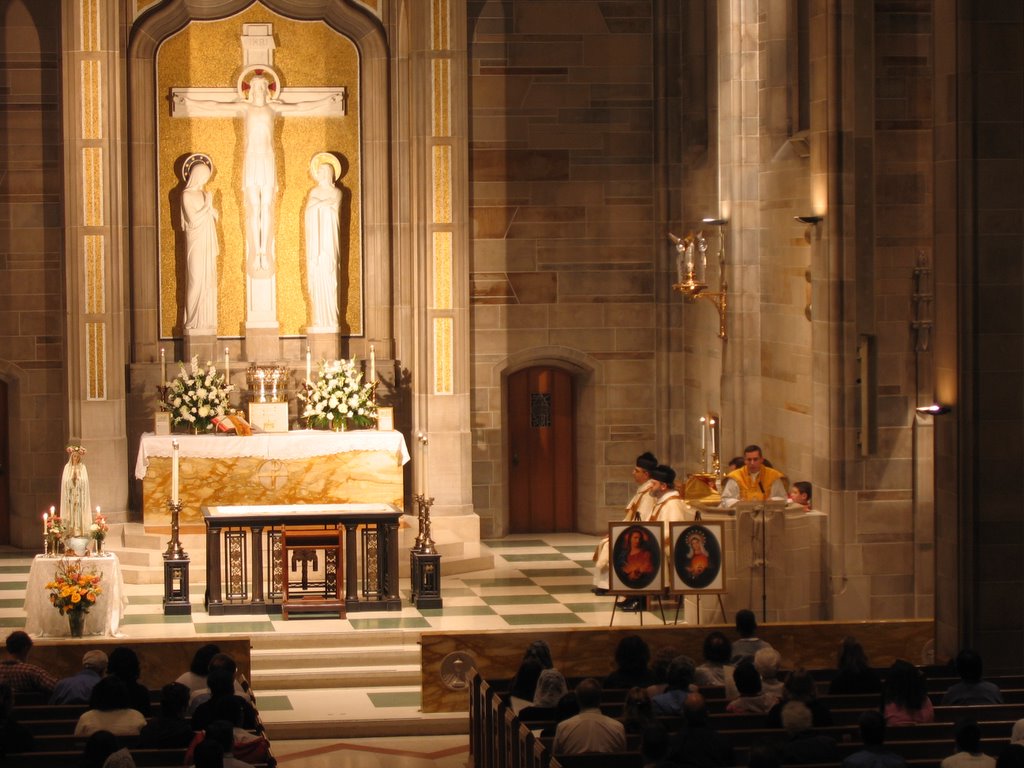
lundi, mars 27, 2006

Sermon for the 4th Sunday in Lent


The joy of this Laetare Sunday is only really experienced by those who have made some efforts during this first half of Lent. They have had to force themselves to remain faithful to their Lenten resolutions and they still have to do so for twenty more days. They must continue to resist the attractions of the flesh and the spirit of the world. Lent is not an easy way for those who choose to take it. They declared war on themselves, desirous of taming their rebellious flesh, so that they can free their spirit. The true liberty of the spirit means to be freed from the passions of the flesh. But, many think the opposite: they believe that freedom is the physical ability to do what they want.

If my dog could speak, she would probably say the same thing, because she has no ability to reason. For a dog, liberty - if we can truly speak about liberty - would be to follow its instincts. In other words, for a dog, liberty would consist in satisfying its biological functions, which are the sustenance of the individual by eating and of the species by the reproduction.

Original sin has caused us to also live as animals, in that, we live solely, and driven by, our biological needs and urges. A French saying tells: Qui fait l'ange, fait la bête! - which means, whoever wants to act as an angel, in the end acts as an animal. Desiring to raise themselves to the rank of God by having the knowledge of good and evil, Adam and Eve fell and lost the supremacy of their reason. Now, every man on earth feels this internal tension that even Saint Paul had and called the law of sin. The great Apostle recognized that even he didn't do the good which he wanted and did the evil which he didn't want.
Spiritual persons suffer in this condition and want to be freed from the body. The carnal persons make the best of it and follow their instincts in order to enjoy life as much as they can. To speak bluntly, their life is essentially about food and sex, as it is for an animal: sustenance of the body and of the species, except that men have abused the proper use of these biological functions and diverted from their proper end, especially in regards to sexuality.

Dear brethren, we are all made with the same natural instincts and so we all have to struggle with the same temptations to greater or lesser degrees. We are all tempted by the flesh and the flesh is threatened by gluttony, laziness, lust, pride, anger, envy and covetousness; what we call the seven deadly sins. At first, they are just temptations, and I remind you that a temptation is not a sin because it doesn't involve your will. A sin is a personal act of a human person. That means an act which involves your intelligence and your will. A temptation is an inclination towards the flesh - when I use the term flesh, I use it the in the manner of Saint Paul. In this way, it does not, necessarily, mean the physical body, but rather something that leads to sin such as a sin of pride.

So, we are all tempted. But there are some Christians who take their spiritual life seriously and act upon the knowledge that the grace of God is more important than the satisfaction of natural instincts. When faced with a temptation, they use the means and the weapons given by God in order to conquer it. This attitude presupposes a regular life of prayer and of mortification. Recall the epistle of Septuagesima Sunday. A sportsman has to train for the victory. How can you resist the temptation of gluttony if you don't fast on occasion? How can you resist the temptation of impurity if you never mortify your senses? How can you resist the temptation of pride if you never accept the humiliations of the life?

Others Christians don't really care about their spiritual life. They think that a sin is not very serious, and that they can just go to confession later. They seem to forget that confession removes the guilt, but not all the consequences of sins. They still must make reparation, and not only in the case of a sin against justice. If they don't make reparation now, they will make reparation in purgatory, that is, if they die without a mortal sin on their souls. But for these people, dying with a mortal sin on their souls is a real possibility and danger because since they don't mortify their flesh and don't strengthen their will, they will fall at the first temptation.

Dear Brethren, if you belong to the first category of Christians, those who use well the time of Lent for the good of their souls, you can really enjoy this Sunday, knowing that your efforts are not vain. You are working for the salvation of your souls, with the help of grace, and I can only encourage you to continue.
If you belong to the other category, may God have mercy on you. You have to choose between God and the world. There is no compromise possible. I can only tell you that you should change your life and start to follow Jesus Christ. You have nothing to loose except your temporal interests. But what do you prefer?

May Our Lady help us to continue our Lenten efforts so that we can enjoy the Solemnity of Easter to the fullest by contemplating Our Lord in His glory. But now, we are still on the way of the Cross, which is the way of life and truth.

samedi, mars 25, 2006

The Liturgical Stakes


The following text is the first speech I gave Monday March 20th in Naples, Florida for a group of Una Voce.

The liturgical stakes
Introduction – Historical overview

The liturgical question is at the core of the current crisis in the Church. The XX century was the century of the liturgical movement. Paradoxically, it was also the century that brought a great many errors and abuses in liturgical matters. But let us not limit this liturgical problem to the only XX century. The History of the Church shows us that this is not the first liturgical crisis we have struggled through. The Church and the faithful didn’t wait for the XX century to take an interest in liturgy. As a matter of fact, the entire History of the Church, back to the very beginning is marked by liturgical questions. And this is perfectly understandable since liturgy is the expression of the faith of the Church and it involves men, who, by our very nature are imperfect.

With the help of Dom Gueranger, I am going to give you a quick overview of the liturgical errors of the past. I will preface by telling you that I am going to speak only about the Roman liturgy, even though the study and the history of other liturgies is very interested. Unfortunately we don’t have time to consider them. In addition to our time limits, I am not the best one to speak on the topic of the liturgies of other rites, since they are not my 'specialty' like the Roman Rite is.

· Early Church to Middle Ages

In the earliest years of the Church, heretics attacked the liturgy, in order to change the Faith. Paul of Samosata, Arius and then the Donatists changed the liturgy of the Church in order to teach their own doctrine. They composed their own hymns and even their own psalms in order to corrupt the Faith by their false prayers as Dom Gueranger says.
Then we have a period of few centuries during which the Liturgy further develops. It is not my purpose to speak about that today, but let us say that the Roman liturgy and the Gallican liturgy merged together into one with a pre-eminence of the Roman liturgy. The unification of the Empire under the reign of Charlemagne helped a lot. The Roman liturgy finally became predominant throughout all Europe.
The XIV and XV centuries knew a certain adulteration, especially in the area of chant. Novelties in the way of singing appeared and Pope John XXII had to intervene with his bull “Docta Sanctorum” in 1322.

· Renaissance

Then came the Humanist period, which provoked some unfortunate attempts at reform. The idea was that the ecclesiastical Latin was too rudimentary. The pontifical court was then full of poets and writers for whom the goal was to reform the Latin and they started to compose again all the hymns for the liturgical year. Pope Leo X himself ordered the composition of a new hymnal. The hymnal of Ferreri – Bishop Zacharie Ferreri was the artisan of this hymnal – was finally approved by a Brief of Pope Clement VII in 1525. According to this Brief, every cleric could choose the prayers he wanted for the Divine Office. Ten years later a new breviary was also approved. It is known as the Breviary of Quignonez, from the name of its composer Francois Cardinal Quignonez. Cardinal Quignonez had the reputation of being a man of great piety and a sincere love for the liturgy. The intention was good: it was to renew the devotion of the clerics. Nevertheless the effects were disastrous, since they were made at the expense of Tradition.
If we take stock of this reform made under the authority of these three Popes – Leo X, Clement VII and Paul III – we can only say that is was a disaster – the word is from Dom Gueranger for whom Romanita cannot be suspected. It must be acknowledged that the University of Paris has censored this Breviary promulgated by the highest authority of the Church
The commentary of Dom Gueranger is pretty interesting. The character of the influence The Holy See exercised on the publication of this Breviary of Quignonez contradicts all that we can see in all the centuries before or after. (That was written in the XIX century!) Rome seems to desire that we use this form of Office but on other hand seems to timid to make it law. We feel as though we are in a state of transition that will last until a Pontiff – Saint Pius V – chosen by God to succeed Leo, Gelasius or Gregory comes and reforms in a saintly way the Divine worship as the Church speaks.
This reform was about the Breviary and didn’t concern the Holy Mass. But the Divine office is still a part of the Liturgy of the Church and what happened in the XVI century can help us deal with the actual liturgical wreck. Dom Gueranger gives us some considerations we can apply, mutatis mutandis, to the actual situation.
- In order first to last, the reform of the liturgy must be done by pious persons and not by erudite persons.
- In a reform of the liturgy, we must beware of novelties.
- Shortening the liturgy is not reforming it!

· The Reformation

The Protestant heresy had much impact on the Liturgy. The idea of Luther was to free man from the servitude of thought regarding the teaching power of the Church and from the servitude of the body regarding the liturgical power.
Dom Gueranger gives the principles of what he calls the “ anti-liturgical heresy.”
- Hatred of the Tradition in the expressions of the Divine worship.
- Replacing the ecclesiastical style words with readings from the Bible. The purpose is to delete what is born from Tradition and to promote the Protestant doctrine with a judicious choice of texts from the Bible. All heresies have their origin in Scriptures, but not on Scripture as a whole, only on carefully chosen passages which support their particular ideas. By the way, the meaning of the word “heresy” in Greek is “choice”.
- The fabrication and introduction into the liturgy of different words in order to spread their doctrine.
- Removing all the words that express the mysteries of the Faith. For examples, they prefer to speak about a table rather than an altar, or about the Lord’s Supper rather than the sacrifice.
- The use of the vernacular for the liturgy. Dom Gueranger says about that: The hatred of the Latin language is in the heart of all the enemies of Rome. They consider it as the good of the Catholics in the whole world, the arsenal of orthodoxy against the subtleties of the sectarian spirit.
- The hatred of the papacy, which is the foundation stone of the entire edifice that is the Church.
- The destruction of priesthood.

· The answer of the Church - a true Catholic Reform: The Council of Trent – Saint Pius V

At the 25th Session of the Council of Trent, it had been decided to entrust the Pope with the reform of the Liturgy. Pius IV began a reform of the breviary but he died and his successor, Pius V continued. The breviary of Quignonez was abolished and replaced by the Roman Breviary.
Then the Roman Missal was restored in 1570. All the dioceses had to embrace this missal except those who had a missal more than 200 years old. Almost all the dioceses of Europe accepted the Missal and the Breviary of Saint Pius V except Milan in Italy and Lyon in France, which had their own antique liturgies.
Then the occidental Church knew many decades of liturgical unity. The reform continued with the publication of the Martyrology, the Pontificale and the Rituale.

· The liturgical deviation in France ( XVII – XVIII )

It sometimes happens that the eldest daughter of the Church is also rebellious daughter. Two important trends would have a great impact on the Church in France until the XX century, these are Jansenism and Gallicanism. These trends had consequences in liturgical matter.
In 1660 Joseph de Voisin, Doctor of the University of Sorbonne published a translation in French of the Roman Missal. The Assembly of the clergy of France immediately condemned this translation. Pope Alexander VII approved this condemnation. In his Brief, He condemned those who have the impudence to translate the Roman Missal, written in the Latin language, into the French language. For the Pope this is a deterioration of the most sacred rites, which debases the majesty that the Latin language gives to them. It is a mark of the hatred of mystery. Finally the Pope prohibited the printing and the reading of the Missal in French under a sentence of excommunication.
That seems to be excessive, especially today since we have now many translations of the Missal in vernacular languages. In the XIX century, when Dom Gueranger wrote his book, there were already many translations available. And Dom Gueranger explains that it is now possible but a translation has to be accompanied by some commentary approved by the Church. Giving the translated text to the faithful without any explanations of the mysteries of the Faith would open the door to numerous and faulty personal explanations.

Then the liturgical attacks came. First was the Rituale of Alet in 1667 whose Jansenist influence was great. The Breviary of Vienne in 1678 and the Breviary of Harlay in 1680 brought more novelties. This Breviary marked the reversal of the work of Charlemagne and the Popes. This Breviary, for the use of the diocese of Paris, created a new Office which had nothing to do with the Roman Breviary. After the Breviary, Harlay, who was archbishop of Paris, published his own missal. The principle was to use only texts from the Bible that was the idea Luther had. Nevertheless, the Missal of the diocese of Paris, in spite of unfortunate changes, was still the Roman Missal.
The Abbey of Cluny went further by exchanging its old breviary for a new one. Once again the idea was to use only the words from the Scriptures. Yet some new compositions by writers of this century appeared anyway, contradicting the purpose the innovators of this breviary had claimed to be their reasoning for the changes. They even changed the liturgical calendar. The admitted goal was to diminish the cult of the Saints, especially the cult of Our Lady.
You will not be surprised to learn that among the members of the committees for the redaction of the breviary of Paris and the breviary of Cluny, were some notorious Jansenists. They attacked the true Faith through the Liturgy.

The attacks were more virulent in the XVIII century. The recitation of the Canon of the Mass in a loud voice appeared as a trend. As Dom Gueranger points out, this was: the seeds of a revolution. Indeed, if we read the Canon in a loud voice, people would ask to read it in the vernacular language. And then, people could become judges in the teaching of the Faith, which is exactly what we see today in so many places. And once again, that had already been the strategy of Luther and Calvin.
The Council of Trent had already condemned this audacity during the 22nd session. Listen to the 9th canon: CANON IX.--If anyone says, that the rite of the Roman Church, according to which a part of the canon and the words of consecration are pronounced in a low tone, is to be condemned; or, that the mass ought to be celebrated in the vulgar tongue only; let him be anathema.
But this didn’t prevent the abuses of the innovators. Thus a new Missal was printed for the diocese of Meaux – the diocese of the famous Bossuet, just few years earlier! Regardless of the integrity of the Liturgy, they introduced novelties in the rubric of the Missal, such some responses preceded by the a big letter R in red to indicate that the congregation has to make the responses just after the words of the consecration and the words of the communion. Thanks be to God, the Bishop of Meaux, who was the successor of Bossuet, did not approve this missal and prohibited it under the sentence of suspension.
But in spite of the orthodoxy of many good bishops and priests – as Father Le Brun, for example, who wrote a very good book about the Holy Sacrifice of the Mass – the novelties increased throughout the entire country.
The Missal of Troye was published in 1736. Its rubrics dictates that the Canon has not to be said “ submissa voce ” – in a low voice – but “ submissiora voce ” – in a lower voice! The Troyen Missal also dictates that a priest who says a solemn Mass does not have to say the prayers and readings sung by the choir or said by other ministers. The altar crucifix and the candles are no longer mandatory. The second Confiteor before the communion was removed. Many texts born from Tradition throughout the centuries were replaced by texts from the Scriptures. A good Bishop, Jean-Joseph Languet de Gergy, archbishop of Sens denounced this Missal for being full of Calvinist conceptions.
The rabid trend of secularization and naturalization of the Liturgy did not abate. The symbolism and mysticism of the rites was attacked. In the name of reason – this was the “Century of Lights” – when it seemed necessary to find an explanation for all, even for the mysteries of the Faith. In accordance with this, they claimed that people needed to understand all the ceremonies of the Liturgy. Hence a simplification of the rites.

The parish of Asnières, a town near Paris, embodied perfectly the goals of the innovators. The pastor at Asnières was Father Jacques Jubé, a zealous Jansenist. Now, let me describe how the liturgy of this parish was – and I remind you this liturgy I am about to describe was a liturgy in the XVIII century.
There was only one altar in the church, called “Sunday altar” because Mass took place only on Sunday and feast days. When there was no Mass, this altar was totally stripped, as every altar has to be on Good Friday. For Mass, they just put one altar cloth and nothing else: no crucifix, no candle. The only crucifix in the sanctuary was the crucifix of procession that preceded the priest as he ascended the altar. After the beginning prayers of the Mass, he went to sit on a seat on the epistle side from where he started the Gloria and the Credo without reciting them in full, nor were the pieces sung by the choir. During the offertory, there was a procession and bread and wine were offered to the priest. Dom Gueranger says this custom was not reprehensible in itself since it was usual in France in many dioceses at this time, and came from an old tradition. The problem was that in the church of Father Jubé, they added fruits and vegetables which they placed on the altar along with the bread and wine to be consecrated. Then the chalice was brought to the altar without a veil. The priest and the deacon said the prayers of the offering of the chalice in a loud voice to signify that they offered it in the name of the congregation. The Canon was in a loud voice also. And there were no specific prayers before communion.
Are you not familiar with this liturgy? I would say, yes, except for one thing. It was still all in Latin. But as you see, our innovators of today have not come up with anything new. They have simply copied the liturgy of the Jansenists from the XVIII century.
We now look at the Missal of Vintimille, published by the Archbishop of Paris, Charles-Gaspard de Ventimille in 1738. In addition to all previous changes made to the Roman Missal, there was now a complete modification of the parts of the Proper in this new Missal of Ventimille. The intention of Archbishop Vintimille was to arouse piety, to make the chant easier to sing and to renew the Faith, Hope and Charity of the people. But as Dom Gueranger continuous to point out, this was also the goal of Popes Saint Gregory and Saint Pius V and there was no need to change what the Church had established. In order to infuse a new richness in the Liturgy, the doctors of the Sorbonne composed new Prefaces, instead of using the traditional Prefaces available in the old Sacramentaries. At the height of these innovations one of the authors was expulsed from the University of Sorbonne as a heretic. Once again, the consequences were disastrous. By the second half of the XVIII century, three quarters of the French dioceses have abandoned the Roman Liturgy. The French Revolution with its Civil Constitution of the Clergy, which created a schismatic Church, would soon foment further confusion.

· The Synod of Pistoia (Italy 1786)

Scipion de Ricci, Bishop of Pistoia, wanted to introduce to Italy the ideas of his friends from France. With the approbation of the Grand Duke of Tuscany, he convoked a “Diocesan Council” as he called it. Here are some of the reforms they tried to impose:
- They wanted to rid the churches of much of their precious and exquisite decorations.
- Reforming religious orders. They shouldn’t have churches open to the congregations. Their Divine Office would be diminished and they would be permitted to have only one or two Masses a day in their churches. The other priests would have to concelebrate.
- Suppressing processions in honor of Our Lady or the Saints.
- Removing pictures of the Sacred heart and any other pictures that express a “false dogma”
- Only one altar in every churches, which should be without relics or flowers
- Use of the vernacular language in a loud voice
- There would be exposition of the Most Holy Sacrament only once a year for the feast of Corpus Christi. A blessing with the ciborium could be given every Sunday.
- They advised against the Station of the Cross


Fortunately, this Synod was condemned by Pope Pius VI with his famous Bull Auctorem Fidei in 1794.

· First efforts of restoration in the XIX

The coming of Pope Pius VII to France for the coronation of Napoleon proved that the love for the true liturgy was not dead in France. The Pope remained four months in the country and everywhere he went, the churches were full and thousands of faithful tried to receive communion from his hand. The spectacle of these crowds singing the Credo in unison with the Pope was a sign of the beginning of the restoration of the Roman Liturgy in France.

This restoration would be done time after time in the dioceses of the country. The restoration of the Benedictine Order by Dom Gueranger in Solesmes would have an important role.


*
* *


Let us now draw some conclusions from this historical overview. First I would say that the Novus Ordo is not, as its name says, new at all. It is rather the outcome – or should I say the triumph? – of the assault by what Dom Gueranger calls “anti liturgical sect.” It appears that Bugnini is not an innovator, but rather a copier of the Jansenists of the XVIII century. But there is a major difference, and herein lies the problem.
In the past all the so-called reforms were made against the will of the Pope, or at least without his approbation. We can wonder about the silence of the Vatican regarding the liturgical experimentation in France in the XVII and XVIII centuries. But a silence from the highest authority doesn’t necessarily mean approbation. In fact, Rome had already spoken at Trent and then through the pen of Pius V. Rome spoke again through Pius VI who condemned the liturgical abuses proposed by the Synod of Pistoia.
But today, the Missal of Bugnini has been requested, approved and promulgated by the Pope, so that we don’t call it the Missal of Bugnini, but the Missal of Paul VI. The Vatican itself has tried to make everybody believe that this Missal is now the only missal for the Roman Church and that the Missal of Saint Pius V has been abolished. Yet, this is a lie.
Thanks be to God, after 30 years of resistance, the Vatican has had to acknowledge that this old and venerable Missal is still in effect, and further, that every priest of the Roman Rite may freely celebrate Mass according to this Missal of Saint Pius V without any specific permission. But this right has yet to be recognized everywhere. The Tridentine Mass still has many enemies everywhere within the Church, as is apparent right here in Naples Florida, even at this very Catholic University.

In fact there is a precedent in History with the Hymnal of Ferreri and the Breviary of Quignonez promulgated with the approbation of the Pope. And for this particular precedent I say, thanks be to God, because this precedent shows us that even with the authority of the Pope, a liturgical reform can be wrong. A good reform, indeed, is not a creation of something new, but a restoration of the Tradition when it happens to have been damaged in some way. And that is what distinguishes the true reformer Popes from the others. On one hand, we find some Popes as Saint Gregory the Great, Saint Gregory VII, Saint Pius V and Saint Pius X. On the other hand, we have Leo X, Clement VII, Paul III and Paul VI.
My intention is not to set these Popes in opposition or necessarily to say that some Popes are better than others, although it is a fact that the great reformers of the Liturgy have been canonized. Maybe it is a strong indication that a good reform can be done only holy persons rather than erudite persons as we have already said. But what is true – and this will be my conclusion for today – is that a good reform brings unity and harmony. We judge the tree by its fruits.

mardi, mars 07, 2006

Meditation of Lent


Giving up movies can be a good penance during Lent, nevertheless there is still one that can help us to enter into the great mystery of Love of Our Lord Jesus Christ. The meditation of the Passion of the Christ is a very fruitful exercice, recommended by all the Doctors and Saints of the Church.The beautiful movie of Mel Gibson is such a grace that can help us for that!

Watch the trailer: http://www.thepassionofthechrist.com/window/med.wmv

lundi, mars 06, 2006

La soumission de la femme


Soyez mes imitateurs, comme je le suis moi-même du Christ.
Je vous loue, [mes frères], de ce que vous vous souvenez de moi à tous égards, et de ce que vous retenez mes instructions telles que je vous les ai données. Je veux cependant que vous sachiez que le chef de tout homme c'est le Christ, que le chef de la femme, c'est l'homme, et que le chef du Christ, c'est Dieu. Tout homme qui prie ou qui prophétise la tête couverte, déshonore sa tête. Toute femme qui prie ou qui prophétise la tête non voilée, déshonore sa tête : elle est comme celle qui est rasée. Si une femme ne se voile pas la tête, qu'elle se coupe aussi les cheveux. Or, s'il est honteux à une femme d'avoir les cheveux coupés ou la tête rasée, qu'elle se voile. L'homme ne doit pas se couvrir la tête, parce qu'il est l'image de la gloire de Dieu, tandis que la femme est la gloire de l'homme. En effet, l'homme n'a pas été tiré de la femme, mais la femme de l'homme; et l'homme n'a pas été créé pour la femme, mais la femme pour l'homme. C'est pourquoi la femme doit, à cause des anges, avoir sur la tête un signe de sujétion. Toutefois, ni la femme n'est sans l'homme, ni l'homme sans la femme, dans le Seigneur. Car, si la femme a été tirée de l'homme, l'homme aussi naît de la femme, et tout vient de Dieu. Jugez-en vous-mêmes : est-il bienséant qu'une femme prie Dieu sans être voilée? La nature elle-même ne nous enseigne-t-elle pas que c'est une honte à un homme de porter de longs cheveux, tandis que c'est une gloire pour la femme qu'une longue chevelure, parce que la chevelure lui a été donnée en guise de voile? Si quelqu'un se plaît à contester, nous n'avons pas cette habitude, non plus que les Eglises de Dieu.
" ( 1 CO XI ; 1-16)
"Que les femmes soient soumises à leurs maris, comme au Seigneur; 23 car le mari est le chef de la femme, comme le Christ est le chef de l'Eglise, son corps, dont il est le Sauveur. Or, de même que l'Eglise est soumise au Christ, les femmes doivent être soumises à leurs maris en toutes choses.
Maris, aimez vos femmes, comme le Christ a aimé l'Eglise et s'est livré lui-même pour elle, afin de la sanctifier, après l'avoir purifiée dans l'eau baptismale, avec la parole, pour la faire paraître, devant lui, cette Eglise, glorieuse, sans tache, sans ride, ni rien de semblable, mais sainte et immaculée. C'est ainsi que les maris doivent aimer leurs femmes, comme leurs propres corps. Celui qui aime sa femme s'aime lui-même. Car jamais personne n'a haï sa propre chair; mais il la nourrit et l'entoure de soins, comme fait le Christ pour l'Eglise, parce que nous sommes membres de son corps, [formés " de sa propre chair et de ses os]. " " C'est pourquoi l'homme quittera son père et sa mère pour s'attacher à sa femme, et de deux ils deviendront une seule chair. " Ce mystère est grand; je veux dire, par rapport au Christ et à l'Eglise. Au reste, que chacun de vous, de la même manière, aime sa femme comme soi-même, et que la femme révère son mari. "
( Eph V ; 22 - 32 )
Qu'en est-il de la soumission de la femme à l'homme, souvent mal comprise, y compris parmi de nombreux croyants ? Avec l'aide des Docteurs de l'Eglise, nous allons tenter d'y répondre.
Saint Paul nous dit dans sa première épître aux Corinthiens que le Christ est le chef de l’homme, et l’homme le chef de la femme. Pour bien comprendre cette affirmation, il convient d’abord de la situer dans son contexte.
Nous sommes au début du chapitre 11ème. Saint Paul commence par demander que l’on soit ses imitateurs comme lui même l’est du Christ. Puis il félicite les Corinthiens pour avoir suivi son enseignement et conservé les traditions. Toutefois, il semble que ce ne soit pas le cas de tous. Déjà à l’époque il semblait y avoir des récalcitrants, ce n’est donc pas nouveau. Aussi après avoir loué les uns, il ajoute comme pour reprendre les autres : « Toutefois je veux que vous le sachiez, le chef de tout homme, c’est le Christ ; le chef de la femme, c’est l’homme. »
De quoi s’agit-il ? Saint Jean Chrysostome va nous aider à le comprendre. « Des femmes découvertes, la tête nue, priaient et prophétisaient. Les hommes laissaient pousser leur chevelure, comme étant versés dans la philosophie ; et ils se couvraient la tête en priant et en prophétisant. Ces deux pratiques étaient d’origine païenne. »
Saint jean Chrysostome explique ensuite que saint Paul s’était déjà exprimé a ce sujet, probablement oralement lors de son séjour a Corinthe. Mais tous n’ont pas suivi son enseignement à e sujet. Aussi y revient-il par écrit en expliquant la cause du précepte : le Christ est le chef de l’homme et l’homme, le chef de la femme.
Il convient ici de s’interroger sur le sens du mot chef. D’abord, comme le fait remarquer Saint Jean Chrysostome, le Christ aussi a un chef : c’est Dieu. Nous avons donc : Dieu est le chef du Christ ; Le Christ est le chef de l’homme ; l’homme est le chef de la femme. En ce qui concerne le Christ par rapport à son Père, il ne peut s’agir ici d’un rapport d’autorité ou de sujétion. Si tel avait été le cas, Saint Jean Chrysostome fait remarquer que
« Saint Paul n’aurait pas parlé de la femme, mais il aurait proposé comme exemple l’esclave et le maitre. Car si la femme nous est soumise, elle reste toujours femme, elle reste libre, elle reste notre égale en honneur. Et le fils aussi obéit à son Père, mais Il reste le Fils de Dieu, il reste Dieu. »
Maintenant, qu’en est-il de la sujétion de la femme à l’homme ? La cause en est dans « la séduction de la première femme » explique encore saint jean Chrysostome. En effet, elle ne fut pas assujettie à l’homme dès la création. Elle fut créée « os des os et chair de sa chair » comme dit Adam. Mais l’Ecriture n’exprime nulle idée de sujétion…. Jusqu’au verdict qui suit la faute en Genèse III,16 : « Tu dépendras de tom mari »
La soumission de la femme à l’homme est donc une conséquence du péché originel et est voulue par Dieu. Je dirais que si l’on à la Foi, cela ne se discute même pas. Et comprenons bien que cette soumission n’est pas une marque d’infériorité, car la femme demeure libre et égale en honneur à l’homme comme Saint Jean Chrysostome nous le rappelait plus haut. Saint Luc ne nous dit-il pas que Jésus était soumis à Joseph et Marie ? Qui irait imaginer qu’Il leur était inférieur ?
D’ailleurs saint Paul précise bien ensuite : « Ni l’homme n’est point sans la femme, ni la femme sans l’homme, en Notre Seigneur », ce qui marque bien la complémentarité des sexes, déjà exprimé au livre de la Genèse. Ceci aussi pour signifier aux Messieurs, que certes, s’ils sont bien le chef de la femme, ils n’en demeurent pas moins que sans la femme, il leurs manquerait quelqu’un. D’ailleurs Dieu a donné la femme à l’homme pour être son associée.

Et où cette association s’exprime t’elle le mieux, sinon dans le mariage ? Voilà pourquoi Saint Paul exige de l’épouse la soumission à son mari, de la même façon que l’Eglise est soumise au Christ. Or qui oserait parler d’une servitude servile de l’Eglise envers le Christ ? Elle est l’épouse pure et Immaculée qui engendre ses enfants et les nourrit par les Sacrements, devenant ainsi vecteur pour les âmes de la vie divine. Est-ce une honte ? Est-ce une infamie ? C’est au contraire une gloire dont nous pouvons légitimement être fiers. Et bien la soumission de la femme envers son mari n’est pas moins noble que la soumission de l’Eglise envers son Christ : elle en est au contraire une belle image.
Et à cette soumission est attaché un grave devoir pour l’homme : aimez vos femmes comme le Christ à aimé l’Eglise et s’est livré pour elle. Tous les maris comprennent-ils le sens de cette phrase ? Comprennent-ils qu’ils ont à ce sacrifier pour leur femme et que s’il le faut, ils doivent donner jusqu’à leur vie ? A y regarder de près, qui a le beau rôle ?
Voici le beau commentaire de Saint Jean Chrysostome :
« Maris, aimez vos femmes comme le Christ a aimé l'Eglise ». Vous avez entendu quelle complète soumission il prescrit : vous avez approuvé et admiré Paul comme un homme supérieur et spirituel, pour avoir resserré ainsi notre société. Ecoutez maintenant, hommes, ce qu'il exige de vous; il recourt encore au même exemple « Maris, aimez vos femmes comme le Christ a aimé l'Eglise ». Vous avez vu jusqu'où doit aller l'obéissance : écoutez maintenant jusqu'où doit aller la tendresse. Tu veux que ta femme t'obéisse, comme l'Eglise au Christ? Veille donc sur elle comme le Christ sur l'Eglise : Fallût-il donner ta vie pour elle, être déchiré mille fois, tout souffrir, tout endurer, ne recule devant rien : quand tu aurais fait tout cela, tu n'aurais encore rien fait de comparable à ce qu'a fait le Christ... Car avant de te dévouer pour ta femme, tu es uni à elle : tandis que le Christ s'est immolé pour ceux qui le haïssaient et l'avaient en aversion. Fais donc pour ta femme ce qu'il a fait pour ce peuple qui le haïssait, l'abhorrait, le méprisait, l'insultait ; sans menaces, sans injures, sans terreur , par l'unique instrument de son infinie sollicitude, il a amené son Eglise à ses pieds. De même, quand bien même ta femme ne te témoignerait que dédain, mépris, insolence, il ne tient qu'à toi de la ramener à tes pieds à force de bonté, d'amour, de tendresse. Car il n'y a pas d'attache plus forte, principalement entre homme et femme. Par la crainte on peut lier les mains à un serviteur, et encore ne tardera-t-il pas à s'échapper : mais la compagne de ta vie, la mère de tes enfants, la source de tout ton bonheur, ce n'est point par la crainte , par les menaces qu'il faut l'enchaîner , mais par l'amour et l'affection. Qu'est-ce qu'un ménage où la femme tremble devant le mari? Quelle joie y a-t-il pour l'époux, quand il vit avec son épouse comme avec une esclave, et non comme avec une femme libre? Quand bien même vous auriez souffert quelque chose pour elle, ne le lui reprochez pas : suivez en cela même l'exemple du Christ... »

A suivre....

jeudi, mars 02, 2006

Message de Careme du Saint Père


Texte intégral de la catéchèse de Benoît XVI sur le carême

ROME, Mercredi 1er mars 2006 (ZENIT.org) –
Voici le texte intégral de la catéchèse que Benoît XVI a prononcée en italien lors de l’audience générale de ce mercredi matin, toute consacrée au Mercredi des Cendres.
Chers frères et sœurs, Aujourd'hui, avec la liturgie du Mercredi des Cendres, commence l'itinéraire quadragésimal de quarante jours, qui nous conduira au Triduum pascal, mémoire de la passion, de la mort et de la résurrection du Seigneur, cœur du mystère de notre salut. Il s'agit d'un temps favorable, où l'Eglise invite les chrétiens à prendre une conscience plus vive de l'œuvre rédemptrice du Christ et à vivre plus profondément leur Baptême.
En effet, en cette période liturgique, le Peuple de Dieu, depuis les premiers temps, se nourrit avec abondance de la Parole de Dieu pour se renforcer dans la foi, en re-parcourant toute l'histoire de la création et de la rédemption. De par sa durée de quarante jours, le Carême possède une force évocatrice indéniable. Il entend en effet rappeler plusieurs des événements qui ont rythmé la vie et l'histoire de l'antique Israël, en nous en re-proposant également la valeur de paradigme: pensons, par exemple, aux quarante jours du déluge universel, qui débouchèrent sur le pacte de l'alliance scellée par Dieu avec Noé, et ainsi, avec l'humanité, et aux quarante jours passés par Moïse sur le Mont Sinaï, qui furent suivis par le don des tables de la Loi. La période quadragésimale veut surtout nous inviter à revivre avec Jésus les quarante jours qu'il passa dans le désert, en priant et en jeûnant, avant d'entreprendre sa mission publique. Nous aussi, nous entreprenons aujourd'hui un chemin de réflexion et de prière avec tous les chrétiens du monde, pour nous diriger spirituellement vers le Calvaire, en méditant sur les mystères centraux de la foi. Nous nous préparerons ainsi à faire l'expérience, après le mystère de la Croix, de la joie de la Pâque de résurrection.
On accomplit aujourd'hui, dans toutes les communautés paroissiales, un geste austère et symbolique: l'imposition des cendres. Ce rite est accompagné par deux formules riches de sens, qui constituent un appel pressant à se reconnaître pécheurs et à retourner à Dieu. La première formule dit : « Souviens-toi que tu es poussière, et que tu retourneras à la poussière » (cf. Gn 3, 19). Ces paroles, tirées du livre de la Genèse, évoquent la condition humaine placée sous le signe de la caducité et de la limite, et entendent nous pousser à placer toutes nos espérances uniquement en Dieu. La deuxième formule se réfère aux paroles prononcées par Jésus au début de son ministère itinérant : « Convertissez-vous et croyez à l’Evangile » (cf. Mc 1, 15). C'est une invitation à adhérer de manière ferme et confiante à l'Evangile comme fondement du renouveau personnel et communautaire. La vie du chrétien est une vie de foi, fondée sur la Parole de Dieu et nourrie par elle.
Dans les épreuves de la vie et face à chaque tentation, le secret de la victoire réside dans l'écoute de la Parole de vérité et dans le ferme refus du mensonge et du mal. Tel est le programme véritable et central du temps du Carême: écouter la Parole de vérité, vivre, parler et faire la vérité, refuser le mensonge qui empoisonne l'humanité et qui ouvre la porte à tous les maux. Il est donc urgent d'écouter à nouveau, au cours de ces quarante jours, l'Evangile, la Parole du Seigneur, parole de vérité, afin qu’en chaque chrétien, en chacun de nous, se renforce la conscience de la vérité donnée, qui nous est donnée, afin que nous en vivions et en devenions le témoin. Le Carême nous invite à laisser la Parole de Dieu pénétrer dans notre vie et à connaître ainsi la vérité fondamentale: qui sommes-nous, d'où venons-nous, où devons-nous aller, quel est le chemin à prendre dans la vie ? Et ainsi, le temps du Carême nous offre un parcours ascétique et liturgique qui, alors qu'il nous aide à ouvrir les yeux sur notre faiblesse, nous fait ouvrir notre cœur à l'amour miséricordieux du Christ.
En nous rapprochant de Dieu, le chemin quadragésimal nous permet de poser sur nos frères et leurs besoins un regard nouveau. Celui qui commence à voir Dieu, à regarder le visage du Christ, contemple également son frère avec un autre regard. Il découvre son frère, son bien, son mal, ses nécessités. C'est pourquoi le Carême, comme écoute de la vérité, est un moment favorable pour se convertir à l'amour, car la vérité profonde, la vérité de Dieu, est dans le même temps amour. En nous convertissant à la vérité de Dieu, nous devons nécessairement nous convertir à l'amour. Un amour qui sache adopter l'attitude de compassion et de miséricorde du Seigneur, comme j'ai voulu le rappeler dans le Message pour le Carême, qui a pour thème les paroles évangéliques: «Voyant les foules, Jésus eut pitié d'elles » (Mt 9, 36). Consciente de sa mission dans le monde, l'Eglise ne cesse de proclamer l'amour miséricordieux du Christ, qui continue à tourner son regard plein d'émotion vers les hommes et les peuples de tous les temps. « Face aux terribles défis de la pauvreté d'une si grande part de l'humanité — ai-je écrit dans le Message de Carême mentionné ci-dessus —, l'indifférence et le repli sur son propre égoïsme se situent dans une opposition intolérable avec le « regard du Christ ». La prière, le jeûne et l'aumône, que l'Eglise propose de manière spéciale dans le temps du Carême, sont des occasions propices pour se conformer à ce « regard »», au regard du Christ, et nous voir nous-mêmes, l'humanité et les autres, avec ce regard. Dans cet esprit, nous entrons dans le climat d'austérité et de prière du Carême, qui est véritablement un climat d'amour pour nos frères.
Que ce soient des jours de réflexion et d'intense prière, au cours desquels nous nous laissons guider par la Parole de Dieu, que la liturgie nous propose en abondance. En outre, que le Carême soit un temps de jeûne, de pénitence et de vigilance sur nous-mêmes, convaincus que la lutte contre le péché ne finit jamais, car la tentation est une réalité de chaque jour et la fragilité et l'illusion sont l'expérience de tous. Enfin, que le Carême soit, à travers l'aumône et les actions de bien à l'égard de nos frères, une occasion de partage sincère des dons reçus avec nos frères et d'attention aux besoins des plus pauvres et des laissés-pour-compte. Que Marie, la Mère du Rédempteur, modèle d'écoute et de fidèle adhésion à Dieu, nous accompagne dans cet itinéraire pénitentiel. Que la Très Sainte Vierge nous aide à arriver, purifiés et renouvelés dans notre cœur et notre esprit, à célébrer le grand mystère de la Pâque du Christ. Avec ces sentiments, je souhaite à tous un bon et fructueux Carême.
[Texte original : italien – Traduction réalisée par Zenit]

mercredi, mars 01, 2006

About Lent


Et cum ieiunasset quadraginta diebus et quadraginta noctibus postea esuriit. Et accedens temptator dixit ei : si Filius Dei es, dic ut lapides isti panes fiant!
Qui respondens, dixit : scriptum est :non in pane solo vivet homo sed in omni verbo quod procedit de ore Dei

( Matthew, chapter 4 )

Our annual exercises of penance begin today for 40 days. During the Septuagesima time the Church reminded us of the necessity to join in the work of Redemption of Our Lord by the spirit of penance. Now it is time to take actions and to do penance. A spirit of penance without any proper act of penance would be an illusion or a kind of hypocrisy.

So, what do we have to do?

First, we must obey the Church who reminds us of something that we are inclined to forget easily:
Can. 1249 The divine law binds all the Christian faithful to do penance each in his or her own way!
But as a good Mother and educator, She clarifies: In order for all to be united among themselves by some common observance of penance, however, penitential days are prescribed on which the Christian faithful devote themselves in a special way to prayer, perform works of piety and charity, and deny themselves by fulfilling their own obligations more faithfully and especially by observing fast and abstinence, according to the norm of the following canons.

We must do penance, but when?
Can. 1250 The penitential days and times in the universal Church are every Friday of the whole year and the season of Lent.
I would add, even if it is not any longer a canonical obligation, that it is also good to do penance during Ember days and vigil days for the faithful of the Traditional Latin Rite.

What kind of penance do we have to do?
Can. 1251 Abstinence from meat, or from some other food as determined by the Episcopal Conference, is to be observed on all Fridays, unless a solemnity should fall on a Friday. Abstinence and fasting are to be observed on Ash Wednesday and Good Friday.

Who is bound by the law of abstinence and fasting?
Can. 1252 The law of abstinence binds those who have completed their fourteenth year. The law of fasting binds those who have attained their majority (18 years), until the beginning of their sixtieth year.
But the canon immediately adds: Pastors of souls and parents are to ensure that even those who by reason of their age are not bound by the law of fasting and abstinence, are taught the true meaning of penance.
So it is important to teach children how much penance is important in their life.

Can we do more than the strict obligation of the Law?
Sure, and you are encouraged by the Church to do more. But you have to be prudent. To do only what the Church command would be a sign of a certain laziness or of a lack of interest for your spiritual life, and finally a lack of love for God. But to do too much would be imprudent or even a sign of pride. In fact, it is good to ask your spiritual director or your confessor for advice.

Here are some examples of penance you can do during Lent :
- Go to Mass more often. If you cannot, read your Missal every day. There is a proper Mass each day during Lent.
- Go to confession more often
- Take more time for the care of your soul ( spiritual reading, meditation, prayer )
- In order to find this time, it would be good to renounce certain activities, as theater, television, parties…
- Give up something ( alcohol, tobacco, sweets…) A certain temperance and moderation is to be observed.
- Make some efforts about charity: helpfulness, visit sick or old persons…

Remember that penance is not an end in itself but a means to be more united to God, especially to Our Lord Jesus Christ who suffered and died for us. Beyond the materiality of our works of penance, a true spirit of love for Jesus Christ and for the souls should animate our penances. Giving up something is a good way to turn to Someone… Someone who loves us and who waits for us. That’s why Lent is not necessarily a time of sadness:
But thou, when thou fastest anoint thy head, and wash thy face; That thou appear not to men to fast, but to thy Father who is in secret: and thy Father who seeth in secret, will repay thee (Mt 6, 17-18)

May God bless you during this Lent.
Father Laurent Demets, FSSP

mardi, février 28, 2006

Septuagesima Sunday

I would like to thank Suzanna, the Mother of my dear little Goddaughter, who helps me by correcting my sermons so that they can be in a better English!

I give her too much works, but this is for the glory of God. So now, I can put online this sermon she has just corrected!


Septuagesima Sunday

The kingdom of Heaven is like a vineyard!

Today’s gospel, behind the simplicity of its words, is very rich and tells us a lot about the Kingdom of Heaven. And Our Lord tells us that this Kingdom is like a vineyard. This image is very well chosen by Jesus who knows how to speak to men with simple words, so they will understand well.
Coming from the country that produces the best wine in the world, I can tell you what a vineyard is about, especially in South of France, just 15 miles from Spain, where my first parish was.
First you might think about sunny slopes, which are like the spurs of the Pyrenees Mountains. The bright blue sky in the Mediterranean, which is reflected by the sea gives a particular brilliance to the nature and if you go there during November, you will be charmed by the palette of colors offered for the pleasure of eyes. The vines with their red and yellows leaves stand out between the azure of the sea and the snow-covered tops of the mountains. Here and there, an old village, a church from the middle-ages or a castle comes into view and adds charm to the exquisite beauty of the scenery, which can help us imagine how Heaven will be beautiful.
But in order to obtain a good wine, men have to work hard. A day of vintage is not without pains, when you have to pick the grapes for many hours over the course of one or two weeks. And the wine growers have to work the entire year to maintain their vineyards, protect the vine plants and then make the wine.
Such is the Kingdom of heaven on earth. Before we may enjoy the wine of the eternal wedding, we have to work hard in the vineyard of God.
The master of the vineyard first calls his workers. We can have, at least, two interpretations of this. God, by his grace, predisposes us to work for his Kingdom. And that starts with our justification. If someone is in state of mortal sin, God gives him actual graces which move him towards contrition and then to confession. For a non Catholic, the grace pushes him towards conversion. Some arrive at the first hour of their life, some others at the second hour and so forth, but in all cases the grace of God was first. We would commit a serious sin by resisting those graces and persevering in our sins. And the temptation is easy to think: I can wait for a while. I will confess tomorrow.. later… But later could be never ! It happens that some non-baptized persons know what they must do to be saved and to please the true God, and yet they postpone the day of their Baptism. Their intelligences have grasped the truth about God and his Church but their wills are not yet ready to take the step. They hear and they know the master of the vineyard’s call, but they don’t dare to come and work. Some 'hooks' of the world still hold them and keep them from following Our Lord Jesus Christ. They perceive the beauty of the vineyard but don’t want to leave their comfortable life for the hard labour. They will say, as the disciples hearing the words of Jesus about the bread of life: This saying is hard and who can hear it ?
Dear Brethren, let us pray for those persons. Maybe they need just a grace that we can obtain, on their behalf, for them to convert. If they knew the gift of God, they would not refuse it.


The second interpretation of this call to work in the vineyard is about a vocation to priesthood or a religious vocation. The care of the vineyard needs some specialists and people who are totally devoted. It will be this group of elite that will push and encourage the other workers towards the time of harvest. Here too, some are called at the first hour, the second or the third, but whatever is the time of their calls, let them not ignore it. Refusing such a grace is, perhaps, not a sin in itself, but it is the refusal of a special gift from God. That means the refusal of the special graces that God has prepared for you, for your salvation and the salvation of many others; and would you not accept those graces? Look at the young man in the Gospel. A good man who worships God. But when Jesus asks him to follow Him, the young man says 'no'. No, because he is wealthy and doesn’t want to give up his material goods.
And you, dear brethren, is there anything that you don't want to give up for Christ?


So let us pray to Mary and ask her to help us to work in the vineyard in order to make it more beautiful. It is hard! But Christ shows us the way and gives us the grace. And then, if he finds us faithful, we will one day appreciate the beauty of His Kingdom and will not suffer any more pain. We could enjoy the wine of the eternal wedding with Jesus, Mary and all the Saints of Heaven.

lundi, février 27, 2006

Pilgrimage to Chartres


24th Pilgrimage of Chartres

June 2006
For the second time, the Chapter Blessed Francis Xavier Seelos, from Mableton GA, will participate in the pilgrimage of Chartres in June.
We will fly from Atlanta on June 1st and return on June 10th.
If you are interested, let me know. You can contact me : Frdemets@aol.com
or by phone : 770 - 313 - 5232
You can also help us by a donation to help pilgrims who cannot pay the whole price. I will say Mass every day during the pilgrimage for all our benefactors.
God bless you
Father Demets

jeudi, février 23, 2006

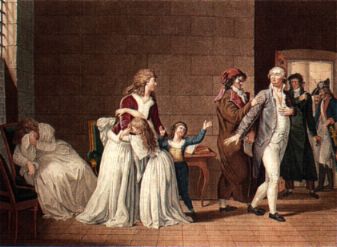
History : Louis the XVI, a Catholic going to death !


I would like to share with you two documents that the French Traditionalist Catholics know well. The first one is the Testament of the King Louis XVI, written on Christmas day, December 25 1792, while he was prisoner and waiting for his execution. It is a beautiful testimony of Faith.
The second is the testimony of Father Henry Edgeworth, the priest who assisted the King during his last moments.
Far from the official History, these two documents show us another reality about the personality of the King-martyr.
Pro Deo et Rege
Father Demets
LAST TESTAMENT OF LOUIS XVI

In the name of the Very holy Trinity, Father, Son and Holy Ghost.

Today, the 25th day of December, 1792, I, Louis XVI King of France, being for more than four months imprisoned with my family in the tower of the Temple at Paris, by those who were my subjects, and deprived of all communication whatsoever, even with my family, since the eleventh instant; moreover, involved in a trial the end of which it is impossible to foresee, on account of the passions of men, and for which one can find neither pretext nor means in any existing law, and having no other witnesses, for my thoughts than God to whom I can address myself,
I hereby declare, in His presence, my last wishes and feelings.

I leave my soul to God, my creator; I pray Him to receive it in His mercy, not to judge it according to its merits but according to those of Our Lord Jesus Christ who has offered Himself as a sacrifice to God His Father for us other men, no matter how hardened, and for me first.
I die in communion with our Holy Mother, the Catholic, Apostolic, Roman Church, which holds authority by an uninterrupted succession, from St. Peter, to whom Jesus Christ entrusted it; I believe firmly and I confess all that is contained in the creed and the commandments of God and the Church, the sacraments and the mysteries, those which the Catholic Church teaches and has always taught. I never pretend to set myself up as a judge of the various way of expounding the dogma which rend the church of Jesus Christ, but I agree and will always agree, if God grant me life the decisions which the ecclesiastical superiors of the Holy Catholic Church give and will always give, in conformity with the disciplines which the Church has followed since Jesus Christ.
I pity with all my heart our brothers who may be in error but I do not claim to judge them, and I do not love them less in Christ, as our Christian charity teaches us, and I pray to God to pardon all my sins. I have sought scrupulously to know them, to detest them and to humiliate myself in His presence. Not being able to obtain the ministration of a Catholic priest, I pray God to receive the confession which I feel in having put my name (although this was against my will) to acts which might be contrary to the discipline and the belief of the Catholic Church, to which I have always remained sincerely attached. I pray God to receive my firm resolution, if He grants me life, to have the ministrations of a Catholic priest, as soon as I can, in order to confess my sins and to receive the sacrament of penance.
I beg all those whom I might have offended inadvertently (for I do not recall having knowingly offended any one), or those whom I may have given bad examples or scandals, to pardon the evil which they believe I could have done them.
I beseech those who have the kindness to join their prayers to mine, to obtain pardon from God for my sins.
I pardon with all my heart those who made themselves my enemies, without my have given them any cause, and I pray God to pardon them, as well as those who, through false or misunderstood zeal, did me much harm.
I commend to God my wife and my children, my sister, my aunts, my brothers, and all those who are attached to me by ties of blood or by whatever other means. I pray God particularly to cast eyes of compassion upon my wife, my children, and my sister, who suffered with me for so long a time, to sustain them with His mercy if they shall lose me, and as long as they remain in his mortal world.
I commend my children to my wife; I have never doubted her maternal tenderness for them. I enjoin her above all to make them good Christians and honest individuals; to make them view the grandeurs of this world (if they are condemned to experience them) as very dangerous and transient goods, and turn their attention towards the one solid and enduring glory, eternity. I beseech my sister to kindly continue her tenderness for my children and to take the place of a mother, should they have the misfortune of losing theirs.
I beg my wife to forgive all the pain which she suffered for me, and the sorrows which I may have caused her in the course of our union; and she may feel sure that I hold nothing against her, if she has anything with which to reproach herself.
I most warmly enjoin my children that, after what they owe to God, which should come first, they should remain forever united among themselves, submissive and obedient to their mother, and grateful for all the care and trouble which she has taken with them, as well as in memory of me. I beg them to regard my sister as their second mother.
I exhort my son, should he have the misfortune of becoming king, to remember he owes himself wholly to the happiness of his fellow citizens; that he should forget all hates and all grudges, particularly those connected with the misfortunes and sorrows which I am experiencing; that he can make the people happy only by ruling according to laws: but at the same time to remember that a king cannot make himself respected and do the good that is in his heart unless he has the necessary authority, and that otherwise, being tangled up in his activities and not inspiring respect, he is more harmful than useful.
I exhort my son to care for all the persons who are attached to me, as much as his circumstances will allow, to remember that it is a sacred debt which I have contracted towards the children and relatives of those who have perished for me and also those who are wretched for my sake. I know that there are many persons, among those who were near me, who did not conduct themselves towards me as they should have and who have even shown ingratitude, but I pardon them (often in moments of trouble and turmoil one is not master of oneself), and I beg my son that, if he finds an occasion, he should think only of their misfortunes.
I should have wanted here to show my gratitude to those who have given me a true and disinterested affection; if, on the one hand, I was keenly hurt by the ingratitude and disloyalty of those to whom I have always, shown kindness, as well as to their relatives and friends, on the other hand I have had the consolation of seeing the affection and voluntary interest which many persons have shown me. I beg them to receive my thanks.
In the situation in which matters still are, I fear to compromise them if I should speak more explicitly, but I especially enjoin my son to seek occasion to recognize them.
I should, nevertheless, consider it a calumny on the nation if I did not openly recommend to my son MM. De Chamilly and Hue, whose genuine attachment for me led them to imprison themselves with me in this sad abode. I also recommend Clery, for whose attentiveness I have nothing but praise ever since he has been with me. Since it is he who has remained with me until the end, I beg the gentlemen of the commune to hand over to him my clothes, my books, my watch, my purse, and all other small effects which have been deposited with the council of the commune.
I pardon again very readily those who guard me, the ill treatment and the vexations which they thought it necessary to impose upon me. I found a few sensitive and compassionate souls among them - may they in their hearts enjoy the tranquility which their way of thinking gives them.
I beg MM. De Malesherbes, Tronchet and De Seze to receive all my thanks and the expressions of my feelings for all the cares and troubles they took for me.
I finish by declaring before God, and ready to appear before Him, that I do not reproach myself with any of the crimes with which I am charged.
Made in duplicate in the Tower of the Temple, the 25th of December 1792.
LOUIS

(Archives Nationales, Paris, dated 25 Dec 1792; given by the King to M. Baudrais, a municipal officer, on 21 Jan 1793, a few moments for he left for his place of execution. Baudrais immediately signed his name to authenticate it and deposited it with the commune, where it was signed and certified by Coulomneau, the secretary, and Drouel, the vice-president).
Procession to eternity

On January 20, 1793, the National Convention condemned Louis XVI to death, his execution scheduled for the next day. Louis spent that evening saying goodbye to his wife and children. The following day dawned cold and wet. Louis arose at five. At eight o'clock a guard of 1,200 horsemen arrived to escort the former king on a two-hour carriage ride to his place of execution. Accompanying Louis, at his invitation, was a priest, Henry Essex Edgeworth, an Englishman living in France. Edgeworth recorded the event and we join his narrative as he and the fated King enter the carriage to begin their journey:

"The King, finding himself seated in the carriage, where he could neither speak to me nor be spoken to without witness, kept a profound silence. I presented him with my breviary, the only book I had with me, and he seemed to accept it with pleasure: he appeared anxious that I should point out to him the psalms that were most suited to his situation, and he recited them attentively with me. The gendarmes, without speaking, seemed astonished and confounded at the tranquil piety of their monarch, to whom they doubtless never had before approached so near.
The procession lasted almost two hours; the streets were lined with citizens, all armed, some with pikes and some with guns, and the carriage was surrounded by a body of troops, formed of the most desperate people of Paris. As another precaution, they had placed before the horses a number of drums, intended to drown any noise or murmur in favour of the King; but how could they be heard? Nobody appeared either at the doors or windows, and in the street nothing was to be seen, but armed citizens - citizens, all rushing towards the commission of a crime, which perhaps they detested in their hearts.
The carriage proceeded thus in silence to the Place de Louis XV, and stopped in the middle of a large space that had been left round the scaffold: this space was surrounded with cannon, and beyond, an armed multitude extended as far as the eye could reach. As soon as the King perceived that the carriage stopped, he turned and whispered to me, 'We are arrived, if I mistake not.' My silence answered that we were. One of the guards came to open the carriage door, and the gendarmes would have jumped out, but the King stopped them, and leaning his arm on my knee, 'Gentlemen,' said he, with the tone of majesty, 'I recommend to you this good man; take care that after my death no insult be offered to him - I charge you to prevent it.'… As soon as the King had left the carriage, three guards surrounded him, and would have taken off his clothes, but he repulsed them with haughtiness- he undressed himself, untied his neckcloth, opened his shirt, and arranged it himself. The guards, whom the determined countenance of the King had for a moment disconcerted, seemed to recover their audacity. They surrounded him again, and would have seized his hands. 'What are you attempting?' said the King, drawing back his hands. 'To bind you,' answered the wretches. 'To bind me,' said the King, with an indignant air. 'No! I shall never consent to that: do what you have been ordered, but you shall never bind me. . .'
The path leading to the scaffold was extremely rough and difficult to pass; the King was obliged to lean on my arm, and from the slowness with which he proceeded, I feared for a moment that his courage might fail; but what was my astonishment, when arrived at the last step, I felt that he suddenly let go my arm, and I saw him cross with a firm foot the breadth of the whole scaffold; silence, by his look alone, fifteen or twenty drums that were placed opposite to me; and in a voice so loud, that it must have been heard it the Pont Tournant, I heard him pronounce distinctly these memorable words: 'I die innocent of all the crimes laid to my charge; I Pardon those who have occasioned my death; and I pray to God that the blood you are going to shed may never be visited on France.'
He was proceeding, when a man on horseback, in the national uniform, and with a ferocious cry, ordered the drums to beat. Many voices were at the same time heard encouraging the executioners. They seemed reanimated themselves, in seizing with violence the most virtuous of Kings, they dragged him under the axe of the guillotine, which with one stroke severed his head from his body. All this passed in a moment. The youngest of the guards, who seemed about eighteen, immediately seized the head, and showed it to the people as he walked round the scaffold; he accompanied this monstrous ceremony with the most atrocious and indecent gestures. At first an awful silence prevailed; at length some cries of 'Vive la Republique!' were heard. By degrees the voices multiplied and in less than ten minutes this cry, a thousand times repeated became the universal shout of the multitude, and every hat was in the air."

References: Cronin, Vincent, Louis and Antoinete (1975); Edgeworth, Henry in Thompson, J.M., English Witnesses of the French Revolution (1938, Memoirs originally published 1815).

mercredi, février 22, 2006

Question !! What is a priest for you ??


A friend of mine, priest of the Fraternity of Saint Peter asked this question on the Forum Catholique, a french website.
The answers were very interresting. This priest told me: why don't you do the same thing in English?
There we go!
So, dear friends, you can answer. What is a priest? What do you expect from your priest? How do you consider priesthood?
Feel free to speak and to share your ideas and experiences.
Thank you and God bless you.

For me, I like this sentence by Blessed Elisabeth of the Trinity :
"The life of a priest is an Advent that prepares Incarnation in the souls."

mardi, février 21, 2006

Sexagesima Sunday

( Sermon - Sunday Feb 19th 2006 )


Saint John Chrysostom was one of the greatest admirers of the Apostle Saint Paul. He wrote about him: we shouldn’t be wrong by comparing Paul’s personality to a grassland where all the virtues grow or to the garden of the Holy Ghost, so much so that the grace abundantly blossomed in him; and he put in all his acts a divine wisdom worthy of the grace received.
The vibrant words of Saint Paul heard in today’s epistle show us his nobility of soul. What a Apostle! What a Saint! And what an example for us! We, who have too often the habit of complaining when something annoys us, can only fall silent after hearing the works of Saint Paul. What have we done for the kingdom of Heaven in comparison to this great Saint? Almost nothing!
And be sure, dear Brethren, that Saint Paul doesn’t list his actions in order to get personal satisfaction or the praises of his fellows. His only concern is the glory of God, and in recognizing his own weakness he gives thanks to God from whom he receives the strength to do all these things.
By acting this way, the Apostle gives us an example, Him who says: Be imitators of me! So, considering this, we have two pitfalls to avoid, these are laziness and pride.
The first one could easily be based on a false humility: “Well I am too weak, it’s not for me! I cannot do that, I don’t have the strength for it.” But do you forget that God wants us do be the workers in his vineyard as we read last Sunday? And all members of the Church, whatever their ranks or states of life, are asked to work in God’s vineyard. So, concretely, what do you do every day for the building up of the Kingdom? Oh, God certainly doesn’t ask you to do the same things he asked for Saint Paul. But He certainly doesn’t want you to remain passive.
Here, we would be well advised to follow the Saint Theresa of Avila’s Advice. Christian life is like a great adventure with its nobility, its passions and its charms but also with its difficulties, its pains and its dangers. The issue is our salvation or our damnation. So, you have to embark on this adventure. If you don’t start one day, there is no chance that you will arrive safe and sound. Ant then, you have to summon up your courage and your patience, because the road is hard. Laziness has no place on this trip. And there are many obstacles you have to overcome. Listen to Jesus’ words in the gospel : Some people hear the words of God; but going their way, they are choked with the cares and riches and pleasures of this life, and yield no fruit.
So, we must be strong, but once again, this strength we need is not ours but God’s. And God doesn’t refuse to give his strength to those who want to follow him with a real and sincere desire. Saint Therese of Avila tells us that we have to go forward every day, contemplating Our Lord and praying to Him constantly. Then we can obtain the strength we need, like Saint Theresa herself, like Saint Paul, like all the Saints who are now in Heaven. But if you give up your prayers, how can you imagine to be able to avoid sin and to remain in state of grace?
There are some Christians who don’t pray or only a little bit and then they become discouraged because they fall regularly in the same sins they have to confess again and again. I would say that is normal. You cannot persevere in good works if you cut yourself off from The One who is the source of all goods. You can still do a natural good, because we have this ability in us, in our nature, but there is no way to do supernatural good, the only type of good meritorious for eternal life. And Our Lord is very clear on this subject: I am the vine: you the branches: he that abides in me, and I in him, the same bears much fruit: for without me you can do nothing. If any one abides not in me, he shall be cast forth as a branch, and shall wither, and they shall gather him up, and case him into the fire, and be burned.
So, it is true: we are weak, as Saint Paul was. But let this be a reason of glory for us as it was for Saint Paul: If I must needs glory, I will glory of the things that concern my infirmity. And don’t find any pretexts in your weaknesses to justify your laziness.
The second pitfall is pride. Pride, in fact, is the root of all sins. And pride is so pernicious that it can change even our best works into a motive of condemnation. Because a proud person is a kind of thief, a thief who steals the most precious good that exists, which is the glory of God. Saint Paul had many reasons to glorify himself, but he didn’t. He knew that all his works were not from him, but from God who gave him the ability, the power and the grace to do that. He was certainly tempted, because the enemy is crafty and knows how to interfere between a soul and God. He tries to fill us with pride, so that we can loose the benefit of our good works and turn away from God.
And the materiality of the good works of proud persons could not save them, because their wills change the goodness of these works into malice. Even their communions instead of giving them life, become an object of reproof. They steal the glory of God and God is very jealous of it. He wants to share his glory with us, but we have to humble ourselves first.
Dear brethren, give thanks to God for the good you do. That’s all. Don’t expect consideration from others, don’t expect any rewards on earth. But just act for the love and the glory of God. I know that is not easy. We like to show our good works. But they are not ours, bud God’s. Whatever I do, I do it with God’s gifts, with the talents He gave me. And they are for the common good, not for my personal glory. We are not the owners of our talents, but just the managers.

Let us pray to Our Lady so that she can help us to avoid these to pitfalls and obtain for us the zeal and the humility we need.

vendredi, février 17, 2006

In Honor of the Immaculate Heart of Mary


Mass in honor of the Immaculate heart of Mary
( Cathedral Christ the King, Atlanta, October the 8th )


Dear Brethren,

It is a great honor for me and a real pleasure to celebrate this Mass in honor of the Immaculate Heart of Mary in the mother-church of our Archdiocese, the Cathedral Christ the King. I would like, first, to thank the pastor, Monsignor Thomas Kenny who allows me to offer the Sacrifice of Our Lord according to the ancient and venerable Liturgy, “ canonized ” – so to speak – by Pope Saint Pius V and, about which Pope John Paul II said few years ago, that it is a treasure of our Church.

I also would like you to pray with me for our Archbishop, her Excellency Wilton Gregory, now in Rome to participate with about 200 bishops from all the world in a Synod led by the Holy Father, Pope Benedict XVI. The stake of this Synod is important since the Pope desires to restore the devotion and the love for the Most Holy Sacrament of the Altar, which presupposes first the respect that, has unfortunately disappeared from so many churches and so many souls. Under the fallacious pretext to make Jesus a friend – that he is truly, we don’t deny this truth – and to celebrate the congregation, we have forgotten the vertical dimension of the Liturgy that connects men to God.
One of the different meanings, relayed by Saint Thomas, of the word “ religion ” in Latin is re-ligare, which signifies: to bind again, to tie again. An authentic Liturgy has to connect us to God, especially today in our world, which is more and more dechristianized. If it is only the celebration of the congregation, the cult of man by man, it is absolutely unable to save us and can only give a false hope that will be finally deceived. Benedict XVI said last Sunday for the opening of the Synod that Without understanding and living the Eucharist, Christian communities would lose their authentic nature.
This statement of the Pope appears to be true. Look how so many Catholics have lost their identity of Catholics. They don’t know who they are and what the Church truly is. Is it not because so many priests have lost their identity of priest? And is it not because these priests have lost the sense of the Eucharist? Forgetting they are first and mainly the men of the Eucharist, they made themselves community workers in social or cultural activities, reducing their priesthood to a natural and horizontal dimension.
The lack of faith of priests in their priesthood and the Eucharist marks the decline of the Church. No other result is possible from this set of circumstances, because the Church lives and grows on the Eucharist and the Priesthood and the two go hand in hand. The Church will recover her identity, her health and her radiance only if She first restores holiness in her clergy and a true understanding and love of the Eucharist in her faithful. And those are two goals of the Holy Father.

Archbishop Jose Mario Bergoglio from Buenos Aires said during the Synod that the faithful link together their love for the Eucharist and their love for Our Lady. It is not surprising that our protestant brothers abandoned the belief in the Eucharist and the devotion for Mary.
The conception of Christ in his human nature took place in the womb of Mary. That was a generation. The Incarnation is a generation that happened thanks to Mary who accepted God’s will. Transubstantiation, that is the change of bread and wine into the body, the soul, the divinity and the humanity of Jesus Christ is another kind of generation. And this one could not happen if the first one didn’t happen 2000 years ago. It is true that, in the absolute, God doesn’t need the help of creatures to operate our salvation, but in the present situation, it appeared that God requested the participation of Mary for this work. And theology, as a true science, doesn’t consider what could be possible but what it is, in fact reality. The fact is that we can benefit today from the fruits of the sacrifice of Jesus because Mary said yes to God.
Stabat juxta Crucem Jesu Mater ejus ! Saint John says. There stood by the Cross of Jesus his mother! She was there, standing despite her terrible sadness at this most dreadful time of the History. She was there, standing in a gesture of offering while she could have been weighed down with sorrows of the agony of her Son. She was there, standing in silence with a perfect submission to God’s will, because she knew with a firm confidence that God’s will is always good, sovereign, infallible and efficient. Didn’t her Son say that he came into the world precisely for this hour? And Mary, by her pressing charity hurried the accomplishment of this hour as it appears at the wedding of Cana.
The Cross and the wedding of Cana refer to Genesis III: I will put enmities between thee and the woman, and thy seed and her seed: she shall crush thy head. According to Saint Maximilian Kolbe, this sentence marks the beginning of a fight in which the woman, who is Our Lady, is engaged. This is the missionary work given by God to The Immaculate. For Saint Maximilian Kolbe, the mission of The Immaculate refers directly to the words of Saint Paul in the epistle to the Ephesians: Finally, brethren, be strengthened in the Lord, and in the might of his power. Put you on the armor of God, that you may be able to stand against the deceits of the devil. For our wrestling is not against flesh and blood; but against principalities and power, against the rulers of the world of this darkness, against the spirits of wickedness in the high places.
And Father Kolbe observed that we are in the front of evil. By contemplating the splendor of The Immaculate, he saw better the devastation caused by sins. So the consecration to The Immaculate makes us more available for the fight to save souls. Our Saint explains that we have to fight on 3 front lines : ourselves, our circles and the whole world. They are focuses where Our Lady is waiting for us and where we can give her the opportunity to work for the Reign of Our Lord Jesus Christ. Heaven is definitively the state of perfection in love, but the earth is still the battle field where nothing is stable and all is to be conquered.
Dear brethren, if you are here now, in the middle of the night, I guess it is because you love Our Lady and you want to be dedicated to Her Immaculate Heart. This dedication is the best way to work for the kingdom of Jesus Christ. But it has to be a true and total dedication, the consecration of your entire person up to the point to become a slave of Mary according to Saint Louis Marie Grignon de Montfort. He said that the Apostle of the last times will be recognizable since they will have the crucifix in one hand and the rosary in the other.

The Cross won over the world and Mary stood by it. Let us stand up after her and follow her until the final victory of her Son. Our weapons are the Holy Sacrifice of the Mass, the Sacrifice of the Cross so hated by the enemies of God and the rosary. Let us confide our communions especially this one to, the Immaculate Heart of Mary, so that she can introduce us into the mystery of love of Our Lord Jesus Christ in whom only we can find salvation.

Amen

L'origine du mal ( Post publié sur le Forum Catholique )


Au sujet du mal

Voici le post promis suite à la question posée il y a quelques jours sur le mal.

Le magistère s’est exprimé à plusieurs reprises pour nous éclairer sur la question du mal.
Nous avons ici un document du Pape Léon Ier au Vème siècle. Réfutant certaines erreurs manichéennes au sujet de l’origine et de la nature des démons, Léon Ier enseigne :
La vraie foi professe que la substance de toutes les créatures spirituelles ou corporelles est bonne, et que le mal n’a pas de nature parce que Dieu, qui est le créateur de l’univers n’a rien fait que de bon. De ce fait le diable serait bon s’il était resté dans l’état ou il a été fait. Mais ayant usé de son excellence naturelle et « n’étant pas demeuré dans la vérité » ( Jn 8,44), il n’est pas passé à une substance contraire, mais il s’est séparé du souverain bien auquel il devait rester uni, de même que ceux qui affirment cela se précipitent eux-mêmes de ce qui est vrai dans ce qui est faux, et s’en prennent à la nature pour ce qu’ils ont commis intentionnellement, et sont condamnés du fait de leur perversité volontaire. Le mal sera d’ailleurs en eux-mêmes, et le mal lui-même ne sera pas la substance mais le châtiment pour la substance.

Le Concile de Braga en 561, sous le Pontificat de Jean III, condamne ceux qui affirment que le diable a émergé des ténèbres et qu’il est lui même le principe et la substance du mal.

Au sujet de l’origine du mal, l’Église affirme qu’en aucun cas Dieu ne peut en être l’auteur. Son origine est bien dans la volonté des créatures rationnelles, anges ou hommes.
Le Concile de Valence en 855, sous le Pontificat de Léon IV apporte quelques précisions, liées à la question de la prédestination :
Par la prédestination, Dieu a seulement déterminé ce que lui-même ferait soit par miséricorde, soit par juste jugement, selon l’Ecriture qui dit : « Il a fait ce qui sera » ( Es 45, 11). Chez les méchants cependant Il a su par avance leur malice, parce qu’elle provient d’eux ; Il ne l’a pas prédestinée, parce qu’elle ne vient pas de Lui.

Attention, la prescience de Dieu ne signifie pas qu’il y ait une nécessité au mal. Cela est difficile pour nous de le comprendre, mais ce n’est pas parce que Dieu voit par avance qu’il y aurait une sorte de fatalisme. Dieu voit par avance nos actes libres. Ainsi, en 483 le Pape Simplicius condamnait ceux qui affirment que la prescience de Dieu pousse violemment l’homme à la mort ou que ceux qui sont perdus le sont par la volonté de Dieu.
Il n’existe donc aucune prédestination au mal, mais seulement à la peine pour ceux qui commettent le mal.

A propos de l’origine des démons, je voudrais m’arrêter sur quelques pensées de Saint Augustin. Saint Augustin fait en effet remarquer que le récit de la Genèse ne mentionne pas la création des anges, bons ou mauvais. Ainsi les manichéens ont pu s’appuyer sur ce fait pour dire qu’ils avaient une autre origine que Dieu. Saint Augustin répond que la Bible en d’autres endroits mentionne les anges comme les œuvres créées de Dieu. Ainsi dans le livre du prophète Daniel dans le Cantique des trois enfants, sont énumérés les anges dans les ouvrages qui doivent bénir le Seigneur : « Ouvrages du Seigneur, bénissez tous le Seigneur… Anges du Seigneur, bénissez le Seigneur… » Idem dans les Psaumes ! Il faudrait ici lire tout le Livre 11 de la Cité de Dieu, tant il est passionnant et instructif. Disons pour résumer que Saint Augustin place la création des anges avec celle de la lumière car « ils ont certainement été créés participants de cette lumière éternelle, qui est la sagesse même de Dieu, sagesse immuable, créatrice de toutes choses que nous appelons le Fils Unique de Dieu. Illuminés de cette lumière qui les crée, ils deviennent lumière et sont appelés jour par la participation de cette lumière et de ce jour immuable, le Verbe de Dieu, leur créateur et le créateur de l’univers. Car la vraie lumière qui éclaire tout homme venant au monde, éclaire aussi tout ange pur afin qu’il soit lumière, non en lui-même, mais en Dieu dont il ne saurait se détourner sans devenir impur, à l’exemple de ces esprits déréglés qui, retranchés de la participation de l’éternelle lumière, cessent d’être lumière dans le Seigneur, pour devenir ténèbres en eux-mêmes ; le mal en effet n’est point une substance : c’est la privation du bien qui s’appelle mal.»
Donc les démons ont été créés bons à l’origine – « Dieu vit que cela était bon » -mais ils se sont ensuite détournés de la lumière. Mais quelle est la cause de la chute des mauvais anges ? Le prophète Isaïe s’interroge : « Comment est tombé Lucifer, qui se levait le matin ? »
La Genèse nous dit ensuite que Dieu sépara la lumière et les ténèbres. Et Saint Augustin commente : « il faut reconnaître ici les deux sociétés angéliques, l’une jouissant de Dieu, l’autre enflée d’orgueil (…) ; l’une brûlant du saint amour de Dieu, l’autre consumée de l’amour impur de sa propre grandeur (…) ; l’une habitant les cieux des cieux, l’autre précipitée d’en haut et refoulée tumultueusement dans les plus basses régions de l’air ; l’une environnée du paisible rayon de sa piété, l’autre troublée de ses ténébreuses convoitises ; l’une, au gré de Dieu, secourant avec clémence et sévissant avec justice, l’autre, que son orgueil livre à sa passion turbulente de dominer et de nuire ; l’une ministre de la bonté de Dieu pour satisfaire à tout son amour du bien, l’autre enchaînée par la puissance de Dieu dans sa funeste passion du mal ; l’une jouet de l’autre, qu’elle sert involontairement par ses fureurs mêmes, et envieuse de sa rivale, quand celle-ci recrute, sur les chemins de la vie, sa glorieuse élite : ces deux sociétés angéliques que d’autres témoignages de la Sainte Ecriture nous montrent différentes et contraires ; l’une de bonne nature et de volonté, l’autre mauvaise de volonté et de nature. »

Ainsi donc le mal n’est pas dans la nature, mais dans la volonté. A ce stade, on peut encore s’interroger. La volonté est une puissance naturelle offerte par Dieu aux créatures rationnelles, donc Dieu ne serait-il pas, au moins indirectement cause du mal, lui qui est cause de notre volonté ? Saint Thomas d’Aquin va ici nous venir en aide. Dans le De Malo ( questions disputées sur le mal ), il s’interroge à la question 3, sur l’origine du péché, qui est le mal moral. Et la 4ème objection est la suivante :
« Tout ce qui est cause d’une autre cause est aussi cause de ce qui est causé par elle. Or le libre arbitre qui est la cause du péché, a Dieu pour cause. Donc Dieu est cause du péché. »
Notons que Saint Thomas donne ici 18 objections…. Vous me pardonnerez d’abréger et de ne vous en livrer qu’une seule ! Voyons comment Saint Thomas répond ( je résume ).
Le péché provient de ce que la volonté déchoit de la fin requise, du fait qu’elle se porte sur une fin indue. Ainsi Dieu ne peut pécher lui-même, sa volonté étant identique à sa nature qui est la Bonté souveraine et qui est la fin ultime et la règle première de toutes les volontés.. Dieu ne peut être cause du péché en péchant lui-même.
Peut-Il être cause de péché en faisant pécher autrui ? Cela voudrait dire qu’Il fasse en sorte qu’une volonté créée se détourne de la fin pour laquelle Il l’a créée, fin qu’Il est lui-même. Or Dieu, souverain bien, tourne tous les êtres vers Lui-même et ne les en détourne pas. En aucun cas Dieu ne peut être cause du péché, même s’Il est cause de la volonté qui est elle-même cause du péché. Voici le texte de la réponse à l’objection :
« L’effet de ce qui est causé se rapporte à sa cause dans la mesure où il est causé. Mais si quelque chose procède de ce qui est causé sans que ce soit sous le rapport précis où il est causé, il n’est pas nécessaire de le rapporter à la cause. » Cela s’embrouille ? Ne paniquez pas, l’exemple suivant nous fera mieux comprendre de quoi il s’agit !
« Ainsi le mouvement de la jambe est causé par la puissance motrice de l’animal qui la meut, mais la déviation de la démarche ne vient pas de la jambe en tant qu’elle est mue par la puissance motrice, mais en tant que son défaut l’empêche de recevoir comme il faut l’influx de sa puissance motrice ; et c’est la raison pour laquelle la claudication n’est pas causée par la puissance motrice. Le péché est donc, d’une semblable manière, causé par le libre arbitre, précisément en tant qu’il s’écarte de Dieu. De la sorte, Dieu n’en est pas la cause, bien qu’il soit cause du libre arbitre.
»

D’ou l’importance du bon usage de la liberté…. Mais cela est une autre question…. Intimement liée à celle du mal…. Mais dont je ne parlerai pas aujourd’hui.

Bonne méditation et bonne réflexion

In Christo Rege

Abbé Laurent Demets