mercredi, août 09, 2006

The Art of Confession

Foreword

The following text is a translation of an article by Father Chery, O.P. Father Henri Charles Chery was a French Dominican priest who wrote many books and articles in the 40’s and 50’s. His writings about the “Christian” sects are particularly interesting. His tracts about Jehovah’s Witnesses, Anabaptists, Quakers, Christian Scientists, Rose Cross and so forth give us much information that can help us to deal with the problems of these sects. Another part of his work concerns the Liturgy.

This article was published in the French review of the Fraternity of Saint Peter, Tu es Petrus, in the issue of July 2005. I want to be most faithful to the original French version. May Our Lady, Refuge of sinners, help us to benefit from the reading of this text for the good of our souls.


Father Laurent Demets, FSSP


Introduction

These lines are neither for the “great sinner” who comes to Christ to relieve his conscience from a heavy burden, nor for the Catholic of the annual Easter confession. But they may offer some usefulness to the person who has the “habit” of weekly, semi-monthly or monthly confession.

“Habit”: an untainted word if it refers to a commendable regularity or a word sadly blackened if it refers to a mindless routine. Unfortunately, every one knows that a commendable regularity can easily degenerate into thoughtless routine. Most of the penitents are upset by the miserable commonality of their confessions and by the little fruits they bear by them and even sometimes by the little interest the confessor shows in giving exhortation when they come to see him. Many take a dislike to this, then confess just by habit or settle for spacing out their recourse to the Sacrament of Penance in a detrimental manner for their spiritual progress.

Does not this dislike and its consequences come because they don’t know how to confess? There is a manner, an “art” that would make this exercise a profitable way of sanctification. By writing these lines, we think especially about the young people, the young Catholic in action, young families, who try to live an authentic Christianity with a generous effort of sincerity. They are not yet formed in the art of confession, and suffer the threat of becoming hardened. They have a horror of routine and they reject formalities. They are right. But they must know that formality comes by the fault of “the customer”, so to speak, and that it depends on them to keep intact their religious vitality or to let it deteriorate for lack of personal effort.


Rites are bearers of life, but only for the living.

The use of confession, if it is well understood, can be a serious support for growth in the spiritual life.

Warning! Confession is not all; contrition and absolution are more important!

But first, because we are speaking about confession, which is our topic, and only about confession, it is to be carefully noted that it is not the whole of the Sacrament of Penance, or even its main element. This Sacrament comprises regret, confession, absolution and reparation. It is essentially constituted by the absolution, which relieves the fault of a repentant heart. So, if a penitent – on his death bed, for example – is unable to express his confession, the Sacrament can work without this confession, but it cannot work without contrition. God, on his part, can dispense with the Sacrament in the absence of any qualified priest being available, but He cannot save a soul in spite of itself and forgive a sin that one refuses obstinately to regret.

People who think their accusation is the main part should remember this. Let the priest exhort them to contrition and to the means to be used for not falling again in their faults, and yet they seem not to pay close attention to him once their confession is made. Rather, they are distracted by their concern to state any sin they have not yet confessed. If it were a grave fault, it would be normal to express it before leaving, but most of the time, their concern is only about venial sins. One worries about being complete; one should rather worry about being contrite.

Consequently, during the few moments we ordinarily take to prepare ourselves for the following confession, we shouldn’t take all this time for the examination of conscience, but rather to implore the grace from God to obtain a sincere regret of our faults and to express our contrition and our intention to not fall again.


Confess to whom?

To whom will I go to confess?
First answer: to a priest! I use these words on purpose to emphasize that we must attach the prime importance, in the use of the Sacrament of Penance, not to the qualities of the man who hears the confession, but to his quality as Christ’s minister. Because we are lacking in faith, we pay excessive attention to the human value of the confessor, which could be a real and objective one or one that our liking and confidence confer to him. We don’t deny that we have to take this into consideration, but on a level standing on the fringe of the Sacrament, so to speak. It will have a role for the advice following the accusation and preceding the absolution, but the Sacrament is not constituted by the advice and can even be absent of it. The matter corresponds to Christ who holds the forgiveness; the living Christ who acts in His Church. Any priest who has received from the Church the power to validly absolve, acts in persona Christi, in the name of Jesus Christ. He opens for your soul the source of forgiveness, which is the blood of Christ the Redeemer, and he cleans it with this blood.

So penitents are wrong because of a lack of faith, when they defer freeing themselves from a grave sin or postpone indefinitely the confession that would free them from a growing uneasiness ( through purifying the sources of infection that spread ) because “their confessor” is away.

If they had the comprehension of what this Sacrament is, especially in its purifying work independently of the quality of the priest who administers it; if they understood that the priest is, first of all “minister of Christ”, that is: the ear of Christ to listen to the confession, wisdom of Christ to judge, mouth of Christ to pronounce the removal; they would give less importance to the human appearances and would not postpone their confession.

Now it is the time to say why I should confess my sins to a priest instead of contenting myself with a confession directly expressed to God in the depths of my heart. It is because I am a member of the Church.

My fault has offended God and injured myself. It is a breach of the love I owe to my Creator and of the virtuous love I should have for the child of God that I am. But my fault also has damaged the Church, the Mystical Body. “Every soul that rises, raises the world.” Every Christian who demeans himself thwarts the Christian community’s perfection. The most obscure sin wounds the tree of which I am a branch. If I totally break away from this tree by a mortal sin, or if only I separate a little bit, the entire tree suffers. I am responsible to the Church in my vitality, because God has entrusted for me his graces to the Church, the body of Christ. So, I must be responsible to Her to overcome my fault. During the first centuries, this responsibility to the Church appeared more manifestly, when the accusation was publicly done in front of the community. Now the discipline has softened, but it is still in front of the Church that I accuse myself, in the person of the priest who hears me, and it is from the Church I receive the reconciliation by the ministry of the priest who absolves me.

So, I confess to a priest because he is a priest. This doesn’t prevent me from choosing a confessor humanly able to understand me and to advise me. We are not speaking now, because it is not our topic, about what we call (maybe a little bit improperly) “spiritual direction”. Even by strictly remaining on the level of the confession, it is surely better for the progress of the soul, that it habitually uses the same confessor. After a while (provided that one follows the advice given about how to confess) the confessor knows who he deals with. He knows your tendencies and your usual weaknesses. Even though you just have a little to say, he knows what point is good to insist on in his exhortation. You have shown little by little the difficulties you struggle with and your own situation and you don’t risk being led astray by an inopportune remark, by a stranger who may misinterpret your situation. At a difficult time of your life, he can stop you on a slippery slope. Anytime, he can suggest to you the right decisions and free you from your spiritual indifference if you fall asleep.


How will you choose him? First, for his straight sense and his reliable judgment. If it is possible, holy – it is clear – but a stable and discerning priest is always preferable to another of a more fervent life but with a less well-balanced judgment. Don’t forget that he is an adviser and as is the wisdom of the adviser such is the advice. But he is a trainer too and you should want him to be demanding. A soft confessor, who would be content with deluding you with lenient words or with sending you away with the absolution and a general exhortation, would take a risk of letting you wallow in your sins or your serious imperfections. And that’s why you must, if necessary, incite the confessor to this beneficial demand and humbly accept his instructions in the effort to change. You will remember that the first condition you must attain before he can be useful is that you trust him.

You may have the best confessor of your town, but if you don’t frankly confide in him, he can’t do anything for you. So, you will choose one with whom you don’t feel paralyzed by his presence and that you can readily consider as an understanding Father, interested in your case and able to deal with it, open to the realities of life, sure in his diagnosis and with a firm goodness in his advice.

If you don’t find him, don’t be distressed; go to any priest: he has the grace of his state and the Holy Ghost will even use him for your good, provided that you will listen to him.
If you find him, don’t change easily. Even though you remain fully free for another choice, don’t be disconcerted by any impressions, any blows to your pride or any demands. Persevere until there is evident proof that you are making no progress with him, in spite of an honest and constant effort on your part.

Which sins to confess?

I am now near the confessional, starting my examination of conscience. Which sins will I confess?
The question comes up, it is clear, for I would not pretend to accuse all my faults. “For a just man shall fall seven times a day” the Scriptures say. What about me, who is not just? How many sins do I commit every day? To be complete and to totally exact all my sins is an unrealistic dream and besides, useless. I must choose. But what shall I choose?


First, you must say all your mortal sins, of course. Refusing deliberately to accuse one mortal sin, even though you confess some others of the same gravity, would make the confession null and sacrilegious. A mortal sin is an act by which you turn away from God, your ultimate end, by willingly telling Him that it is all the same for you to disobey Him in a serious matter, so that you can satisfy your disorderly tendencies. So, how can you obtain the grace of God if you don’t repudiate a mortal sin, and then if you don’t confess it? You cannot be both in friendship and in hostility with God.
The difficulty, in certain cases, is to know when there is a mortal sin. In theory, everybody knows: grave matter, mindful of the serious wrong and full consent. In practice, we often wonder: was the matter grave? And more often: did I really consent? It is easy to ask your confessor about the first question. For the second one, the fact that this question comes to your mind and you honestly wonder in conscience and the fact that you are not absolutely sure bring the answer: there was not full consent. Does that mean you don’t have to confess this “doubtful” sin, or rather this sin “doubtfully committed?” Certainly not! You can legitimately permit yourself on the basis of doubt to come to the Sacrament of the Eucharist. Strictly speaking, there is no necessity to confess this sin. But if you want to make progress in the spiritual life, you would be wrong to take refuge behind this non-obligation when the doubt is a question in your conscience. Practically, the rule is very simple. You are not required to accuse yourself for having committed a mortal sin, but for having committed such sin or such act.

You can add, if need be: “I don’t know if I have fully consented” and that will be all right. There still will be a time for answering in conscience if the confessor asks you: “Do you think you committed a mortal sin by doing this?”

What about this phrase constantly used by certain people: “I accuse myself as God recognizes me as guilty[1]?” It can be used with good reason when you hesitate over the nature of your guilt, but it seems to be too easy and a little bit hypocritical when you know well, what it is about.
On the other hand, let us say to certain souls, that you don’t have to consider any sin as mortal. A sin that deserves separation from God for eternity and the pains of hell cannot be committed without a clear conscience of it. If your conscience has to be developed, you will ask your confessor for some explanations and you will firmly keep his advice. The development of the conscience should be made during childhood. Hearing children’s confessions, we are stunned by their aptitude for believing that some slight faults are mortal sins. By the way, is there not here a certain responsibility of the educators who should know how to proportion their scolding to the real value of the child’s fault? Anyway, the problem of the development of a child’s conscience should be well examined by parents and usual confessors, because it is dangerous to let children believe in the gravity of a slight fault as well as to let them consider as unimportant an act that is seriously reprehensible. A scrupulous and anxious conscience during childhood later makes an adult weak, apt to fail and without strength of character; or sometimes, as an aftereffect, a teenager who suddenly frees himself from an unbearable constraint.

Mortal or not, it would be better to confess the sins that lay the most heavily on your conscience, rather than slipping them in the middle of a long list of sins of less importance. Doing this you are sure to be freed from faults that otherwise you could fail to say because of a silly fear.

But I would like now to focus particularly on the examination and the accusation of venial sins. Is it not on this matter that most of the penitents accustomed to a frequent confession are the most deficient?
What kind of complaints do we often hear from these penitents? – “Confession bothers me because I always have the same things to say.” Or this, about the confessor: “He doesn’t tell me anything!” Understand: anything out of the ordinary that pushes you to shake yourself.
Well, the cause of these two defects that make confession psychologically tedious is the same: You don’t know how to confess!


How do most of the penitents confess?

Some penitents (only a few) forget that sin is an act and not a state, so they show (or they believe to show) the color of their souls by saying: “I am a liar; I am impatient; etc…” This way of expressing is improper. Saying it like this you indicate a tendency of your soul. But confession is not a statement of your tendencies: It is the accusation of precise actions, which are certainly the results of your tendencies, but different from them as the fruits differ from the tree. You can have a tendency to lie ( be a liar ) and have not told lies for the last two weeks since your last confession. If you have lied, you must say: “I have lied” and not: “I am a liar.”

Now, most of the penitents confess like this: “I have lied, I have lacked charity, I have been lazy, I have been vain, etc…” This form is more correct, but the accusation is hardly better. I mean, hardly profitable for your soul and hardly susceptible of obtaining useful advice from your confessor. Why? Because your confession is neutral. You didn’t need any particular thought and any efforts of resolution to do it. It doesn’t give to your confessor any particular description that permits him to see how your soul is different than the one he has just judged and advised before you. On ten penitents who follow each other, at least nine could show the same list – as a matter of fact, alas, they do!

So, why do you expect your confessor to give you the precise advice you need, advice for you and not for another? Your particular case is not revealed by your confession which gives him no means to grasp an understanding of you. He would need to be a wonderful and intuitive psychologist in order to guess, through this fast series of standard faults and through the screen of the confessional where he cannot see your face, to know what words he should tell you that could reach and encourage you to make the efforts you personally must make. We cannot expect all confessors to be a Curé d’Ars! Normally, a confessor will give you back what you have brought to him.

In addition, if the penitent begins a long listing, in which he wants to be exhaustive, and if he means to tell almost all the venial sins that one can commit – in fact that he has probably committed – so that the listing is said fast and lasts many minutes, then the confessor is totally bogged down and wonders: “Is there anything characteristic in this confession?” Thus, finding nothing particular, he just gives a general exhortation, which is hardly useful. Who’s to blame?

So, how do I confess well?

Let us first emphasize that venial sins are free matter concerning confession. You are not obliged to confess them. An act of contrition well done, a true act of love of God or the use of a sacramental with faith and humility qualify for obtaining forgiveness of them. Therefore, a confession which comprises only venial sins is not necessary for salvation. It is rather a way of sanctification. It is recourse to a Sacrament, by which we are cured and strengthened through the purifying blood of Jesus. It is also, secondarily, an exercise of humility based on the knowledge of yourself and the accusation of what holds up your spiritual progress. So, you are free to choose the venial sins you want to confess among all those you have committed.

Does that mean you will choose the slightest and push into the background the most embarrassing? No! It would be the opposite. A good examination of conscience should cause to emerge from the multitude of your daily sins, those which are the most dangerous for the vitality of your soul, because of their frequency or of their malice. The personal characteristic features of your own sinful soul are not similar to another soul’s, like your face is not similar to another. We all roughly commit the same sins, as we all have a nose, a mouth and ears. So the importance, for you, of such a fault, and the place it takes in your spiritual life and also its nearness to other faults of the same kind, is what compose your face as a sinner. This is what a skillful examination of conscience brings out. It is useless to accumulate a long list of sins in confession: five or six, well chosen, would be enough to see yourself and to show you as you truly are in front of God.

Now comes maybe the most practical remark. You still have to tell your sins with their own reasons and circumstances. “I have lied!” This signifies nothing. Psalm 115 says: Omnis homo mendax – every man is a liar. In what way did you lie? To whom? In what circumstances? Why?
“I have lied to a sick friend who expected my visit, because it annoyed me to do it.” This is a lie with a particular quality. “ I have lied in a salon by claiming that I have some relations which actually I don’t have; I have lied to my superiors in order to obtain a day off which I was not entitled to; I deceived a customer about the quality of my work in order to be paid more...” The simple confession “I have lied” would not give a precise idea of the quality of your sin.
“I have lacked charity” – the most common sin! Why do you use this neutral expression? Say rather: “I have said to someone I don’t like hurtful words, knowing that it would distress him” or “I have despised a classmate not very intelligent” or “I have refused to help a friend who was in need” or “I have made fun of a disabled person.”

There are so many ways to be vain. What about yours? Do you spend too much time for your grooming and dressing? Do you look at yourself in the mirror at every turn? Do you display your talent every time you are in company and try to attract attention by your brilliant conversation?
What about your laziness? How does it show up? By your obstinacy to stay in your bed when it is time to get up? By neglecting your duties and failing to accomplish what you are supposed to do? By your nonchalance in your behavior or an exaggerated love for comfort?

These few examples – we could find more – help us to understand what we mean when we say that you have to confess precise acts with the circumstances in which you have done them. Find the keywords which are the most capable of expressing your fault as it has really been committed by you and not by just anyone. It is for your own benefit. First, because it compels you to see yourself as you truly are; then because it is a salutary humiliation (it is more humiliating to say: “I have spent half an hour a day to make up my face” rather than: “I have been vain.”); and finally because your confessor can see the state of your soul from what you say and can give you suitable advice.

Having said this, you are not invited to chatter. Confessing with precision is not “telling stories.” Confession is not supposed to be drowned in a flow of accounts, explanations and digressions in which the penitent forgets that he confesses his sins and the confessor doesn’t understand what your sins are. Sometimes priests hear a so called confession as a justification or defense; sometimes as an evaluation about someone else; sometimes as a complaining about the hardness of the present time. It is quite legitimate to need to unburden your heart and to receive consolations, or to ask for explanations for your life. But in this case, separate the two matters: do your confession first by just telling your faults; then tell the priest that you have something else to say.

In what manner should I confess?

As we have already said several times, the priority to be valued in the Sacrament of penance is the purification by the blood of Jesus Christ, not the exhortation of the confessor. This purification is obtained by contrition. This truth involves a consequence regarding the manner in which you bring your faults to the tribunal of penance: you don’t have to enumerate your sins, but to confess them.
Every priest who hears confessions is struck every day by a kind of indifference, at least seemingly apparent, displayed by many penitents who state their faults. They enumerate their sins and draw up a list. If it is well done, it seems that they have accomplished what the Church expects from them. Then they just have to receive the absolution and leave freed. The formality is done.
But it is not the case. Nothing is “formality” in the field of religious acts. You don’t have to fulfill the obligation to attend Mass, but to participate in it. Confession is not about a duty you must do, but is essentially a matter of retraction and disavowal of the evil you have done, so that you can be forgiven. It is a matter of love, a matter of heart (i.e. of will). You come to acknowledge you did evil, you lacked the love due to God by refusing to do one of his wills (the will that we must be honest, just, pure, loving etc…) It has to be manifested by the way you tell your sins. Confiteor! (It is recommended to recite “Confiteor” (I confess) before you start your accusation.) “I confess; I recognize; I admit; It is my fault; I am guilty; I beat my chest.” So your accusation has to be along this line. It is not about noting that you have been evil and bringing this fact to the knowledge of the priest. You have to express the regret for having been evil.

Therefore, it would be good to repeat for each fault: “I accuse myself of…” It would be much easier if you accuse only a few sins.[2] It helps to avoid falling into a kind of indifferent coldness through contenting yourself in just relating your sins instead of confessing them.


Is it appropriate to accuse some sins of your past life already forgiven in previous confessions?

As an exercise of humility, this could be good to recognize yourself once again, as guilty of an old sin already forgiven, if this doesn’t bring any trouble to your conscience. A second good reason is that the Sacrament will bring its purifying grace in a special manner to the source of infection from where this sin formerly came, which may not be totally cleansed.

It can also be good, in certain serious occasions of your life (before marriage, before taking vows, during a retreat etc…), to make a general confession regarding the last past year or a longer period. But there is a condition: it should not be done because of a conventional custom, but because you really need it. You must be pushed by an interior necessity, not by the fact that it is a custom, especially during retreats.

Nevertheless, some people may abstain from looking at their past life. These are the scrupulous. The scrupulous persons are sick and their sickness precisely consists of an anxiety which makes them unable to know if they have done something or not, or if they have done something right or wrong in such an action. They want to be sure, and the more they look for certitude, the less they are sure. In the confessional, they want to be sure that they have completely said all or that they honestly have true contrition, but for never being sure, they indefinitely repeat. Indeed, it is an exhausting search which increases their sickness while pretending to soothe it. There is still one way to be cured: obeying the confessor with no discussion. He will give the order to close one’s eyes on the past in an absolute manner.

The firm intention

There is a kind of concern which is not only peculiar to scrupulous people and that even sincere people know. This concern expresses itself as such: “Why do I have to tell this sin? I probably don’t regret it because I know I will commit it again.”
This matter is about the firm intention.

First, let us clearly distinguish: “foreseeing that I will fall again” and “wanting to fall again”.

For sure, a penitent who wants to fall again and who is decided to repeat his fault at the first occasion is not a penitent. He has no contrition. He misuses the Sacrament and deludes himself about the effectiveness of the absolution which cannot clean a sin if its author doesn’t disown it. Thanks be to God, this is not the usual case.
Most of the penitents have a keen feeling of their weakness which is justified by the unfortunate experience of their relapses. They think that their good intention, severely tested once again, will not be more effective than it was previously. And they conclude: “I don’t have contrition!” This is a mistake. They basically call “evil” the evil they have done; they wish they had never done it and would like to be able to avoid it now. So, this is contrition.
In order to forgive us, God does not require that we are sure to not sin again. This certitude would be very similar to presumption. He simply asks us to have the intention to do what we can with the help of His grace to avoid sinning again. Is this our intention? Then we don’t have to fear hypocrisy and insincerity. Our gloomy forecasts should not change our intention. In reality, a gloomy forecast in itself is a sinful mistrust of the grace available in the Sacrament. The sacrament of Penance is really a means to progress, not mainly because of the psychological effort it imposes on us, but rather it applies to our sick soul the expiatory blood of Jesus Christ which is its remedy. Jesus doesn’t only grant his forgiveness by the merits of His Passion, but He also gives us some purifying graces and strength for the struggles we still have to pursue, especially graces regarding the sins we have confessed. We should have confidence in those graces, not in the problematic capacities of resistance of our good will.

So, don’t worry about “tomorrow”. Tomorrow’s grace will be sufficient for tomorrow as long as you keep confidence and continue to pray. Today, you have the grace of today, which is a grace of contrition. Bearing now in your imagination the temptation of tomorrow is bearing a burden for which you do not have help. It is no wonder if it seems to you too heavy and crushing.

This is not the sense of being unconcerned, because the accusation involves a resolution. You will entrust the execution of this resolution to the help of God and you will have to work to keep it. In order to be effective, a resolution must be precise, about such or such sin to avoid, not about all the sins you have confessed. You can even do better by considering, from the experience of the past, the circumstances that may lead to a fall and the occasions which can push you to sin. Then you can focus your resolutions on occasions which you must avoid.

For example, if you know that certain company pushes you to gossip, particular reading lead you to impurity[3], such opening a drawer in your mind revives bitterness or such conversation rouses your anger, then your resolution will be to shun this company, to give up this reading[4], to leave this memory as a closed drawer or to avoid this subject of conversation. Acting this way is considering yourself as you really are. You can succumb in such an occasion while someone else would remain strong. Acting this way, you are not tempting God by putting yourself in danger. Finally, acting this way is being logical with your contrition.

After your accusation of sin, why not guarantee your resolution by submitting it to your confessor? This would help you to keep it better.

Conclusion

If you follow this advice, your confession will no longer be a tedious repetition of “standard” sins and a chore as it too often is. It would rather be one of the most powerful means of sanctification that the Church offers to you. When you go to the tribunal of penance, you will be aware that you go to Christ on the Cross who holds in His crucified hands the forgiveness He obtained for you with His blood. Aware of your misery, particularly since you will more easily understand your daily weaknesses and be confident in God’s mercy, especially since you will beg Him for obtaining the hatred for your sins, you will step into the confessional with the humble disposition of the prodigal son: “Father, I have sinned against heaven, and before thee, I am not now worthy to be called thy son.”

This is why you can leave with a new strength, based on a liberating assurance: “ Go in peace my son; thy faith has made thee whole.”
* * *

[1] In French: Je m’en accuse comme Dieu m’en reconnaît coupable.
[2] Remember this advice is for people who confess regularly.
[3] The same remark applies to television which can be a frequent occasion of sin.
[4] Or this TV programme.

mardi, juillet 25, 2006

lundi, juillet 24, 2006

Into great silence


La Grande Chartreuse
(France)


"Into Great Silence" is a very strict, next to silent meditation on monastic life in a very pure form. No music except the chants in the monastery, no interviews, no commentaries, no extra material. Changing of time, seasons, and the ever repeated elements of the day, of the prayer. A film to become a monastery, rather than depict one. A film on awareness, absolute presence, and the life of men who devoted their lifetimes to God in the purest of form. Contemplation. An object in time. "Into Great Silence" is the first film ever about life inside the Grande Chartreuse, the mother house of the legendary Carthusian Order in the French Alps.

mardi, juillet 18, 2006


The Lord is the strength of his people, and the protector of the salvation of his anointed!


Sermon for the 6th Sunday after Pentecost
Today’s Introit, taken from the Psalm 27, comes to invigorate our faith and our hope. “The Lord is the strength of his people, and the protector of the salvation of his anointed.” It is good for us, and comforting, to open the Holy Scriptures and to read these verses which sustain our Christian life. God is my strength and the protector of my salvation!

Dear Brethren, when you are beset by doubts, when you are tempted with discouragement, when you are tired because you have so many tasks to complete, when you cannot see the light at the end of the tunnel, when you just want to give in and admit defeat, just remember that Our Lord Jesus Christ is your strength. This thought made Saint Paul exclaims: “ If God be for us, who is against us?

I particularly like this verse from the Epistle to the Romans which I chose for my card of ordination: “If God be for us, who is against us?” God is our strength and our protection and no one nor anything can stop us or knock us down if we are with God under his protection. Who is against us? Of course, by choosing God, we build up an army of enemies against us, but what can they do against us? Even if they take our life, it would only be for our benefit.

So, dear Brethren, we have no excuse for giving up our duties toward God, especially the sanctification of our soul which is truly a duty. Temptations? They are no excuse. Difficulties? They are no excuse. Our weakness? It is not an excuse either. Certainly, we can fall, and God knows how very weak the flesh is, but we cannot give up our duties and push God out of our life just because we think that we cannot do what He wants us to do. What a trespass against Him! What a lack of faith! What a shame! Nothing can justify such abandonment.

Dear Brethren, by choosing God, we don’t take the easiest road. It is again Saint Paul who tells us that we are baptized in the death of Jesus Christ. We are buried with Him. It is not just a kind of image, a beautiful thought expressed in a poetic way. We are truly dead and buried with Jesus Christ and with this truth come certain very real responsibilities which we can sum up and condense into one word: the Cross!
The Cross of Jesus Christ! We like to have it on the walls of our rooms, that’s nice, but we usually don’t like to have it on our shoulders. Yet, on our shoulders is the most appropriate place for the cross. We like to understand the idea of the Cross and to think about it, but we don’t like to carry it. Yet, before we can have a beautiful concept to understand and contemplate, it is first an object we should embrace and carry. The Cross is our way to salvation and the source of our life. There is no salvation and no life without the Cross.

Now, comes the usual objection: “But I cannot carry this cross. It is too heavy! O God, please, I would like to carry my Cross with Jesus, but please, give me another one!”
O men of little faith! Don’t you know that God knows better than you what is good for you? Don’t you know that He is perfectly wise and that He gives each of us what we need? If God gives you one cross instead of another, it is because this cross is the perfect cross for you. And, rest assured, that He will give you the strength to carry it.
The Lord is the strength of his people, and the protector of the salvation of his anointed.” Where will you find the Lord? Where will you find the strength and the protection He promises us? Right here, at the altar, in the Sacrament of the Eucharist. Listen to Jesus: “If I shall send them away fasting to their home, they will faint in the way; for some of them came from afar off.” Our home is heaven and it is far from here. God knows this and gives us the food which makes us strong enough to be able to reach our eternal home. Pope Saint Pius X, after having condemned the Jansenist belief to the contrary, teaches that Our Lord desires for us to receive Him every day in the Sacrament of the altar. This pious practice strengthens our union with Our Lord and is the best way to keep our soul in the state of grace.

Dear brethren, the Lord is your strength and I hope you will not be fools by rejecting Him. The fact is, that without Him, you will fall time and time again in mortal sin. Yet, God gives you the means to keep your soul in the state of grace. Don’t offend Him by rejecting His graces.

May Our Lady lead us to the altar and help us to prepare ourselves for Holy Communion. It is already the early beginnings of Heaven.

lundi, juillet 10, 2006

Sermon for the 5th Sunday after Pentecost

Dear Brethren, I hope you have understood and taken to heart the following admonition of Our Lord, because it is a serious one. “For I tell you, that unless your justice abound more than that of the scribes and Pharisees, you shall not enter into the kingdom of heaven.”

What is the justice of the scribes and Pharisees? It is a justice which is only concerned with appearances. Their justice consists of making themselves look like very pious Christians, because it is very important for people to see how good and holy they are. It is a display and sometime a show of their qualities and abilities. When a parish has the grace to number such gifted persons among its ranks, it is very important that everyone in the parish recognize their talents and the least we can do is to congratulate them for this. Scribes and Pharisees, indeed, don’t like to work for nothing. They appreciate flattery so much, that it would be a disgrace to refuse to shower them with compliments. Finally, their justice is their glory. The glory of God is the least of their worries, even though they claim the contrary. But we recognize them not by their words but, instead, by their actions and one day, their action will end up betraying them. It has always been the same story from the beginning of time, and yet there are still today some Pharisees who believe that they can be right and successful. It’s amazing how much pride can make us blind.

So, the scribes and the Pharisees regard themselves highly just because they know well the teaching of the Church, or at least, they think they know it well, and they zealously follow the divine precepts, except the most important one which is the commandment of charity. They come to the Church and they want to be sure that we can see them praying, singing and accomplishing the acts of our holy religion with a great care, but their heart is dry. They recite their prayer, but they don’t pray. They worship God like a robot, but they don’t love Him like a man. This is all their justice. Poor and miserable Christians!

And what about us, dear Brethren? Don’t we have the temptation to be like them? We would like to judge them, and by doing this, we become like them. Certainly, they are wrong, there is no doubt about this, but unless our justice abound more than theirs, we shall not enter into the kingdom of heaven.

May Our Lady give us this perfect justice which come from God only. We should read and meditate on the epistle of today, and ask for the grace to be able to apply it in our lives. Saint Peter tells us what is justice according to the heart of Jesus. This should be our justice, which abound more than the scribes and Pharisees.
Amen!

samedi, juillet 08, 2006

A new Superior General for the Fraternity

On Friday 7 July 2006, the General Chapter of the Priestly Fraternity of Saint Peter, gathered in Wigratzbad (Germany), has elected
Fr. John Berg as Superior General
for a six-year term according to law.

An American citizen, Fr. Berg has studied philosophy in the USA and theology in Germany (Wigratzbad) and in Rome. He has worked in pastoral ministry and as a seminary professor. Very Rev. Fr. Berg is the third Superior General of the Priestly Fraternity of Saint Peter.
We would like to congratulate Father Berg for his election and assure him of our prayers.
We also pray for all the priests and seminarists of the Fraternity, especially for Father Devillers who has been our Superior General for the last six years.

lundi, juillet 03, 2006

Tu es Petrus...


...Et super hanc petram
aedificabo
Ecclesiam meam.
Who is the Son of man?” When Jesus asked this question, it was not the first time that he used the expression “Son of man”. Nevertheless, many people were apprehensive about Him. For some, the Son of man was John the Baptist; for others, he was Elias; and for others still, He was Jeremiah or one of the prophets. No one among them confessed that He was the Messiah, the Son of God. Many Jews recognized in Jesus an extraordinary man, but they didn’t confess his divinity.

This error is still relevant today. The majority of people believe in Jesus, or at least in a certain Jesus, but among them, many don’t believe that He is God. Their belief might be a path toward Faith, but it is not yet Faith and as such is useless for eternal life. For some, Jesus was a great man, maybe the greatest man in History. For others, he was just an avatar of the divinity, the same as Buddha or Krishna for example. But He was not the Son of God who came into the world to save us. They don’t recognize this truth as yet necessary for their salvation.

But whom do you say that I am?” Now, this is the question which is asked of you. Remember, the priest asked you this question one day; the day of your baptism. “Do you believe in Jesus Christ, His only Son, Our Lord, who was born into this world and who suffered?” Do you believe that Jesus Christ is the Son of God, God Himself and your unique Savior? The answer is either yes or no. You either believe or you don’t, and the fact that you believe or not will affect your entire life and most of all your eternity. The words of Jesus are clear and final: “He that believes and is baptized, shall be saved: but he that believes not shall be condemned.”

These words seem hard to hear, especially today in a world of relativism that has swept away all notion of truth in the name of reason even though truth is precisely the object of reason. Once, Jesus had asked for an act of Faith for the Eucharist. He said: “For my flesh is meat indeed: and my blood is drink indeed. He that eats my flesh, and drinks my blood, abides in me, and I in him.” But reason, revolting against what it cannot understand, had cried out: “This saying is hard, and who can hear it?” Then, Our Lord had turned to the Twelve, expecting from them the right answer of Faith. This had to come from the mouth of Simon-Peter: “Lord, to whom shall we go? Thou hast the words of eternal life. And we have believed and have known, that thou art the Christ, the Son of God.” This was the profession of Faith of Capharnaum.

Today, Jesus asks another question. “But whom do you say that I am?” Once again, the answer comes from Simon-Peter: “Thou art Christ, the Son of the living God.” This is the profession of Faith of Caesarea.

Peter knows that Jesus is the Christ, the Son of God. His knowledge comes from God, not from flesh and blood. Reason cannot discover this truth by itself. We can confess the divinity of Jesus Christ only by Faith.! “Blessed art thou, Simon Bar-Jona: because flesh and blood hath not revealed it to thee, but my Father who is in heaven!” Blessed is he who believes this! Blessed is he who has Faith!

Right after his proclamation of Faith, Our Lord appointed, Simon the rock upon whom He would build His Church. Simon became Peter, which means rock in Hebrew – Kephas – and Christ promised to give him the keys of the kingdom of Heaven with the power to bind and lose. In other words, and it is not difficult to understand this, Peter was established chief and head of the Church. His ministry is mainly and essentially a pastoral ministry, which means that Peter must protect and defend his flock and lead it to the eternal pasture land. The word “pastoral” has been overused for the last past decades, to the detriment of the word “dogmatic”. It is nonsense because ‘pastoral’ and ‘dogmatic’ don’t contradict each other, but, instead, suppose each other. Peter, who is the universal pastor of the flock is also the keeper and the defender of Faith, because without Faith, the flock is lost. Dogmas are nothing other than Faith expressed in human words and an attempt to apprehend as much as we can, the mystery of God.
Feed my sheep!” The sheep of Jesus Christ need a substantial food and the milk of a good doctrine. They are given to us by the Church, through the Sacraments and Her teaching. Peter is the head of the Church. As such Sacraments must be performed and celebrated in communion with him; and he is the guarantor of the teaching of Faith.

Let us pray to Saint Peter, chief of the Apostles, and for his successor, Pope Benedict XVI. Let us pray especially this week for our General Chapter, as well as for the General Chapter of the Society of Saint Pius X.

May Our Lady, Queen of the Apostles, help Peter and his task, for the highest glory of God and the good of all the faithful… and there shall be one fold and one shepherd

lundi, juin 26, 2006

Sermon
for the
3rd Sunday
After
Pentecost
Man has the inclination to be the judge of his brothers and to impose upon them his own point of view. Let us be honest, we all have this tendency, don’t we? Let us put ourselves for one moment in Mister Know-it-all’s shoes, which could be anyone of us. I said Mister, but it could be a Miss or Mrs. too. In this matter I do believe in sex equality.

" It is well known that I know everything better than everybody else, so I know what is good and what is evil for everybody. And since I have sufficient knowledge, I can pass judgment on my neighbor who is necessarily less knowledgeable than me; or, if by chance he is more knowledgeable than me, then he is certainly much too proud, which makes him too blind to see the truth, which I, of course, know so much better than he. Because of me, of course, I am humble and I cannot be wrong. "

Well, Mister or Mrs. Know-it-all – again, who could be anyone of us – is not a child of Adam and Eve for nothing. Their sin, which we call original sin, is not only theirs. It is ours too. You can give the excuse that it was not your fault and that you have nothing to do with it, but the Church still reminds you that this sin is truly yours. You didn’t commit it personally, but you were born with it and all its consequences. One effect of original sin is the corruption of the good of nature. We acknowledge with Saint Thomas Aquinas the four wounds of nature which are ignorance, malice, weakness and concupiscence. Let us understand well that we are all affected by these wounds. Every human person comes into this world in such a state, except Our Lady who was preserved by a unique privilege.

We know this, I would say on a theoretical level but for some strange reason and as if by magic, we seem to forget this on a practical level, at least when ourselves are concerned. It is not difficult to notice how ignorant or malicious our neighbor is, but when it comes to looking at ourselves, our nature becomes reluctant to recognize our own defects.
At first sight, this observation can make us laugh, but in fact it is alarming, because it is simply the opposite of what we are supposed to be. Look at the Pharisees of the Gospel. Jesus does good around Him everywhere He goes. But He doesn’t act according to their social criteria. “ Can you imagine? This man receives sinners and eats with them! What a disgrace! ” And they murmur with a vengeance.

We may have good reasons to be indignant about their behavior, but don’t forget one thing. We are no different than them. And it is quiet a paradox. We claim that we are Christian, and traditionalist Catholic on the top of that; we assert that we have nothing to do more precious than doing God’s will; we militate in favor of the social reign of Jesus Christ in the society; we are supposed to be disciples and friends of Jesus, and yet we act like His enemies. Like them, we are indignant when our neighbor does good. And if he does something evil, it is immediately an outcry and we are so happy to be the one who throw at him the first stone.

But what kind of Christians are we? Why don’t we rejoice with Our Lord when we see good around us? Why are we so indignant, so hard and so prompt to judge instead of being compassionate and merciful? Are we imitators of the Pharisees or of Our Lord Jesus Christ? As Traditionalist Catholics, are we keepers of the Traditions of Jesus Christ or of the Pharisee’s?

Dear Brethren, it now the time to choose. Let us turn to Our Lady so that She can help us to make the good choice, which is of course, Our Lord Jesus Christ. May She help us to see evil first in ourselves, so that, with the help of grace, we can cure ourselves first of our own sins and defects. It will be a better way to glorify and serve God, definitively better than making ourselves righter of wrongs.

samedi, juin 24, 2006

Sacred Heart of Jesus

Romanesque church of Paray-le-Monial

Sermon for the solemnity of the Sacred Heart

Cathedral Christ the King, Atlanta

Paray-le-Monial is a pretty little town in the South of Burgundy, surrounded by the Saone River and the vineyards which make this place quiet peaceful and pleasant. There, one can enjoy the charms of the provincial life, a life for which France has the secret. We should say that Burgundy, which is famous all over the world for the finest wines, is also an old land rich in tradition, and is considered to be one of the main roots of France and even Europe. Her influence has been profound for many centuries, to such a point that even the King of France could fear her at the time when she was allied to England. Saint Jeanne of Arc would learn this at the expense of her life.

Burgundy is also an old Christian land. A visitor will be amazed by the great number of churches, priories and monasteries that punctuate her soil. Who doesn’t know the name of Cluny which was a thriving spiritual, cultural and even political center during the Middle Ages? Paray-le-Monial is one of the numerous fruits of Cluny.

Around the year one thousand, some monks from Cluny founded a priory there. Restored in the XIX century, this church is a finial of the Romanesque architecture with its octagonal bell tower which symbolizes the eighth day, the Day of the Resurrection. In 1632 a community of the Visitation, Order founded by Saint Francis de Sales and Saint Jeanne de Chantal, settled in Paray-le-Monial. 45 years later, a young woman took her religious vows in this community. She is named Marguerite Alacoque and would become famous as Saint Marguerite-Marie. Jesus has chosen her to reveal the mysteries of His Sacred Heart to the world. Paray-le-Monial had to become the city of the Sacred Heart.

It is true that the devotion to the Sacred Heart of Jesus knew a great impulse after the apparitions of Paray-le-Monial, but this devotion had existed previously. I would say it started with Saint John who rested his head on the Heart of Jesus. Later, Saint Catherine of Sienna said that the disciple, hearing the beating of this Heart, experimented the depth of love by which Jesus saves the humanity. The same Saint John, the only one faithful Apostle during the agony of Our Lord, saw the Heart of Jesus pierced by the soldier’s spear, “ and immediately there came out blood and water.” Saint Augustine has these wonderful words to explain this verse. The side of Jesus has been opened. “ Actually, the door of the life had to be opened at the place where the Sacraments of the Church rose. Without the Sacraments, it is impossible to get the life, which is the only one veritable. This blood has been shed for the remission of sins; this water is a salutary liquid because it is used as a bath and a beverage.”

And then Saint Augustine shows how this event was prefigured a long time ago. “God had announced this event when He gave to Noah the order to open a door in the side of the ark. By this door, the animals destined to not die had to enter. These animals prefigured the Church. This is also the reason why the first woman has been draw from the side of Adam while he was sleeping. This is the reason why she received the name of the life and of mother of the living. The second Adam, Jesus-Christ, after bending his head, fell asleep on the Cross, so that a spouse was given to Him. During His sleep, this spouse came out of His side.” Saint John, faithful Apostle, was witness of the birth of the Church, born from the Heart of Jesus.

Then, during the Middle-Ages, the devotion to the Sacred Heart, was carried mainly by the German and Flemish mystics, and also Saint Catherine of Sienna in Italy. In 1246, Saint Lutgarde had a vision of Jesus who asked for her heart. She answered: “Give to my heart the love of Thy own Heart. May my heart be well protected in Thee, forever under Thy protection.” Let us also mention Saint Mechtilde of Magdeburg and Saint Gertrude who were both presented with revelations of the Sacred Heart.

But that was not enough for Our Lord who is thirsty of love. His Heart had to be more known and more loved. Saint Marguerite-Marie would be the instrument of propagation for a renew of the devotion to the Sacred Heart. By December 27th 1673, Jesus told her: “ My Divine Heart is so heated of love for men of for you especially, that It can no longer restrain in Itself the flames of Its ardent charity. It has to spread them by your means and to show up to men in order to enrich them by Its precious treasure that I reveal to you.
Then, came the great revelation of June 1675, during the Octave of Corpus Christi. that you probably already know: “Behold this Heart which has so loved men that it has spared nothing, even to exhausting and consuming itself to prove to them its love.In return, I receive from the greater number nothing but ingratitude, contempt, irreverence, sacrilege, and coldness in this Sacrament of my love.But what I feel still more is that there are hearts consecrated to me who use me thus.

The message is clear. Jesus loves us and His love has no limit. But He is not loved and He will be less and less loved. After the XVII century will come the century of Lights, which is the prelude of the French Revolution. The Catholic order must be destroyed and Satan launches his troops in the world. For being the Eldest Daughter of the Church, France is at the center of the battlefield. Our Lord gave also a message to Saint Marguerite-Marie for the King Louis XIV. She might inform the King of France, "Eldest son of His Sacred Heart," that the Sacred Heart claims "to reign in his palace, to be painted on his standard, to be engraved on his arms"; and that it will make him "triumphant over all the enemies of Holy Church." Either Louis XIV never received the letter or he refused to reply, we don’t know. It has never been done, and instead of triumphing over the enemies of the Church, France sank into the horrors of the Revolution. Many Catholics, and first the King-Martyr Louis XVI, many priests and religious paid it with their life. Once the temporal order destroyed, it would be more easy to annihilate the spiritual order.

Heaven tried to warn us. Our Blessed Mother visited us many times at Lourdes, Pontmain, La Salette and Fatima where She promised the victory of Her Immaculate Heart, so intimately united to the Sacred heart of Her Son. Yet, the world turns a deaf ear. Today, the Sacred Heart is probably less loved than ever. More than ever, we must do reparation. And the way to make reparation, which has been given to us by Jesus, is the Holy Sacrament of the Eucharist. Remember, the great revelation took place during the Octave of Corpus Christi. Our Lord said to Saint Marguerite: “ Therefore I ask of you that the Friday after the Octave of the Blessed Sacrament be kept as a special festival in honor of my Heart, to make reparation for the indignities offered to It and as a Communion day, in order to atone for the unworthy treatment It has received when exposed upon the altars.I also promise that my Heart shall shed in abundance the influence of Its Divine love on all those who shall honor It or cause It to be so honored."

Saint John Eudes, a great apostle of the Sacred Heart composed an Office and a Mass of the Sacred Heart. In 1856, Pius IX established this feast as a first class one for the Universal Church. In spite of the hostility of the Governments and of all anticlerical laws in France since the Revolution, the Devotion to the Sacred Heart knew a great growth, especially during World War I. The Basilica of the Sacred Heart of Montmartre in Paris is one of its most visible fruits in Europe as the huge statue of Rio de Janeiro is in the New World. And how many invisible fruits cannot we count in so many souls all over the world?

My dear Brethren, we are here tonight, in this Cathedral of Atlanta, to celebrate the Solemnity of the Sacred Heart of Jesus. We are here to try to bring more love to Jesus, abandoned too often in so many places throughout the world. It is very sad to see so many churches closed in Europe and everywhere else. There are no longer priests in a great number of parishes. Consequentially, there are no more faithful. Saint John Mary Vianney used to say that if a parish remains a few years without a priest, then people will worship animals. Look! What do people worship today? Money, sport, themselves etc… But who cares about God, and especially God in the Sacrament of the Eucharist? In 1675 Jesus said that He received from “the greater number nothing but ingratitude, contempt, irreverence, sacrilege, and coldness in this Sacrament of my love.” And what about today?

Dear brethren, members and friends of the Alliance of the two Hearts, it is our mission and our duty to be the apostles of the Sacred Heart of Jesus and consequently of the Immaculate Heart of Mary. Remaining passive would make us cowards and deserters at this time of struggle. What are the means by which we must do this? It is simple: prayers, sacrifice and Sacrament. In other words, we must be saints so that Our Lord Jesus Christ will be more loved. And I would like to insist on the Sacrament of the Eucharist. We must receive communion in reparation for sins. Listen to the twelfth promise of Jesus to Saint Marguerite-Marie: “In the excess of the mercy of my Heart, I promise you that my all powerful love will grant to all those who will receive Communion on the First Fridays, for nine consecutive months, the grace of final repentance: they will not die in my displeasure, nor without receiving the sacraments; and my Heart will be their secure refuge in that last hour.” How unbelievable is this promise, fruit of the excess of the Divine Mercy! Don’t you hear the call of your Savior who wants you to receive Him in this great Sacrament? The love of the Sacred Heart is inseparable from the love of the Sacrament of the Altar. One who loves the Sacred Heart is thirsty to receive the Holy Eucharist.

Logically and consequently the love of the Sacred Heart and of the Eucharist goes with the love of priesthood. It was again Saint John Mary Vianney who told in so beautiful words: “Priesthood is the love of the Heart of Jesus.” I wish, we, priests, could understand what that means with all its practical consequences. I wish you too, dear Christian faithful, could understand.

So go to the priests! Receive from them the Sacraments, especially at the communion rails – at least in the churches where the iconoclastic madness has not removed them – and in the confessionals. Sacraments are the gifts from the Heart of Jesus crucified. Go to the priest and ask them to come to your homes for the solemn enthronement of the Sacred Heart in your families. There are so many graces to receive from that. Go to the priests and hear from them the teaching of our good Master who wants nothing but our love. And if they, perchance, teach a new gospel as it happens sometimes, or maybe often, then tell them with charity that they might be on the wrong path and pray for them. Finally, pray for the vocations. And don’t pray to obtain good priests, but pray for holy priests. They will demand more from you, but it is for your own good. They will not tolerate your faults and your wild behavior, because tolerance is not the virtue of the saints, and sometime they will correct or reprimand you, but it is for your own good. They have better than tolerance to give you. They are the ministers of the mercy of God. Most of all, they will give you Jesus Christ and only Jesus Christ, because they are priests just for this reason. Priests are the elect chosen by God to dispense the treasures of grace of the Heart of Jesus.

And Jesus is the Son of predilection loved by the Father from all eternity. Nevertheless the Father sent Him to death, because He also loves us. What a great mystery is the love of God for us! “For God so loved the world, as to give his only begotten Son; that whosoever believeth in him, may not perish, but may have life everlasting.”
Dear brethren, let us not be resistant to such a love. Let us love as Jesus loves us, with no limit. You may think that it is not possible. Yet, it is possible, with the help of grace.

May the Immaculate Heart of Mary lead us to the Heart of Jesus so that we can be witness of the love of God for men.

Jesus meek and humble of heart, make our hearts like unto Thine.

Amen !

dimanche, juin 18, 2006

Lauda Sion Salvatorem


Sermon for Corpus Christi
Bonum est diffusivum sui. This old philosophical adage shows the nature of goodness to propagate itself. Saint Thomas Aquinas sees here the fitness of the Incarnation. God wanted to become a man because He wanted to communicate to us His goodness. Since His very nature is goodness, God communicates Himself through the Person of His Son, true God and true Man.

But before to communicate Himself to men, God, first, communicates Himself…to Himself. Father Marie-Vincent Bernardot writes: God is an Ocean of life, and this Life, which is Light and Love, is thirsty for the spreading and giving itself. From all eternity, the Father gives Himself to His Son. Together, the Father and the Son give Themselves to the Holy Ghost, communicating to Him their unique divinity.

So, the communication of His Life to men is like a continuation and a prolongation of the intimate life of God into his creatures. Jesus is the Way, chosen by God to communicate His Life. Father Bernadot says again that the whole Divine Life flows in Him. The sacred authors give evidence of this truth. Because in him, it hath well pleased the Father, that all fullness should dwell, as Saint Paul attests (Col 1,19). And you know well the verse by Saint John that we hear during the last gospel: we saw his glory, the glory as it were of the only begotten of the Father, full of grace and truth.

Jesus, as a man, has received all from His Father and His mission is to communicate all that He has and even more; I would say all that He is. The Life of God is now given to us by and through Jesus Christ and here appears the fundamental and essential necessity of Divine grace. I am sure that you know your catechism very well and that it is not needed to remind you what the sanctifying grace is. Nevertheless, just in case your memory is faulty, let us recall that the sanctifying grace is a supernatural gift from God that makes us children of God by allowing us to participate in His nature. This one sentence involves so many consequences that I have to encourage you to meditate on it and to read about it, because it is impossible to explain all in one sermon. At least, I hope that your are aware that, if you are in state of grace. If this is not the case you have the opportunity to confess right after Mass. In this, you are participating in the Divine Nature of God and you can be called his children.
The Sacrament of Baptism incorporates us into the Mystical Body of Christ and gives us the grace. In this Mystical Body, Christ is the Head from which we, the members, receive all graces. In his very remarkable Encyclical Letter, Mystici Corporis, Pius XII shows how the Church can truly be called the body of Jesus Christ because He is the Founder, the Head, the Support and the Savior of this body. The Pope points out how the unity of the Body is strengthened by the Eucharist which is the physical Body of Jesus under the species of the bread and of the wine. This Sacrament is really the Sacrament of the Unity. Listen to Pope Pius XII:
"By means of the Eucharistic Sacrifice Christ our Lord willed to give to the faithful a striking manifestation of our union among ourselves and with our divine Head, wonderful as it is and beyond all praise. For in this Sacrifice the sacred minister acts as the vicegerent not only of our Savior but of the whole Mystical Body and of each one of the faithful. In this act of Sacrifice through the hands of the priest, by whose word alone the Immaculate Lamb is present on the altar, the faithful themselves, united with him in prayer and desire, offer to the Eternal Father a most acceptable victim of praise and propitiation for the needs of the whole Church. And as the Divine Redeemer, when dying on the Cross, offered Himself to the Eternal Father as Head of the whole human race, so "in this clean oblation" He offers to the heavenly Father not only Himself as Head of the Church, but in Himself His mystical members also, since He holds them all, even those who are weak and ailing, in His most loving Heart. "


Dear brethren, I would like to insist on the communal character of the Eucharist. Certainly, there is an intimate and very personal relation between Jesus and every single soul, but we cannot deny the communal and even the social aspect of this Sacrament. The procession we will have after the high Mass will help us to keep this truth in our minds. It is a public recognition of the Majesty of God and a public act of Faith in the real presence of Our Lord. In a Catholic country, the authorities pay tribute publicly to the Sacrament and the militaries salute and present arms before the Sacrament. In the old days, the entire community was involved and everybody participated in the procession: Officials, guilds, confraternities etc… A procession was very a social event. Of course, this is not the most important thing, but it is an indicator of the vitality and influence of Catholicism in a society.

As the Head of the Mystical Body, Our Lord have influence on all the members. He is the source from whom we receive grace and life. When someone is united to Jesus, he acts under the motion of the divine grace and his being is transformed. What is true for a person is also true for a community of persons. If there are enough people in a society who live united to Jesus, then this society itself is marked by Jesus. Grace changes not only the person but also societies.

The Eucharist brings the Divine Life of God into our souls. Then, full of grace and truth like Jesus, we become a light for the world and a way of conversion. I have already told you many times: the way we behave in front of the Holy Sacrament reflects our feelings toward God. Nonchalance and immodesty have no place in a church. And what about your inner feelings that only God can know? Do you think that jealousy or resentment are the right attitude for a Christian who is about to receive his Lord?

The Eucharist brings the Divine Life of God into our souls, yes, but we have to be well disposed to receive it. God wants to communicate Himself, but sadly too many people are not well disposed to welcome Him. Now, God is not forcing us. If we are not ready to welcome Him, He will not come by force. Then His grace will decline, and finally the Catholic religion will give way because so many Catholics are weak and half-hearted.

Dear brethren, it is now the time to stir up ourselves. It is the right time to return to your Lord in the Sacrament of the Eucharist. It is the time to renew your devotion and your fervor for such a Sacrament. It is the time to give yourself to Jesus as He gives Himself to you.

May Our Lady give us the love of the Eucharist which will make us ardent and zealous apostle of Her Son. May she help us to receive the Divine Live of Jesus in our souls for our greatest joy and the highest glory of God.

dimanche, mai 14, 2006

The true dignity of man


Sermon for the 4th Sunday after Easter
Every best gift, and every perfect gift, is from above, coming down from the Father of lights.” If we think a little bit about this, we can see that among the gifts from God, there is one especially which should catch our attention. It is the greatest gift given by God and it outshines every other thing He ever made. It is His work for which He especially cares with a particular interest. This masterpiece is nothing else but man himself. We are, as Saint James asserts, some beginning of His creatures.

It is certainly not a matter of chronology. We are not the beginning of his creatures according to the succession of time since it appears that we were created after all other creatures on the 6th day, just before God rested on the 7th day from all His work which He has done. So, being some beginning of His Creatures means that God thought about us before every other Creature and that He Has created others for men.

Saint Gregory of Nyssa, one of the Cappadocian Fathers – and not the least – says that "among all the marvels of the world, no one can push man into the background. Man probably even surpasses all the other creatures because none of these is in the image of God except him." Saint Bernard admonishes us: "Agnosce, o homo, dignitatem tuam, agnosce gloriam conditionis humanae – recognize, O man, thy dignity, recognize the glory of human condition."

What exactly is our dignity? God is Spirit and Word. Saint Gregory of Nyssa says again that our "human nature is very close to this. Look at yourself. You will see speech and thought, images of the true Spirit and the true Word." God is also love. And there is love in us. This is what makes the difference between us and animals.

But you might ask: “what about the angels? They are superior to us.” Yes, you are right, but they are superior to us according to their nature. Nevertheless God has given to us a precious good that not even the angels have received. He became one of us. And the Word was made flesh! This is our greatest dignity which every man must recognize. Ignoring, denying or despising the truth of the Incarnation, apart from the fact that it is a sin against God, is a snub against mankind. For that reason, we must let the world know that Jesus Christ is God made man who came to save us. We must! It is not we may if we wish, but we must! And “we” is each one of us who are present now, each one of you who are listening to me now.

How can someone recognize his dignity if he ignores who is at its origin? Human Rights may be something good in itself, but speaking only of Human Rights without any reference to God is an illusion, or a lie when it is deliberately wanted by the enemies of the Religion. It would be good not to forget that the Universal Declaration of the Human Rights is purely a product of the French Revolution which was violently hostile to the Church. Pope Pius VI condemned it.
Bishop Gaume, a great defender of the Catholic Faith in the XIX century wrote about the Revolution: "If you unmask the Revolution and ask her: Who are you? She will answer: I am not what you think I am. Many speak of me but few know me. I am not Freemasonry, nor rioting, nor the changing of the monarchy into a republic, not the substitution of one dynasty for another, not temporary disturbance of public order. I am not the shouts of Jacobins, nor the fury of the Montagne, nor the fighting on the barricades, nor pillage, nor arson, nor the agricultural law, nor the guillotine, nor the drownings. I am neither Marat nor Robespierre, nor Babeuf nor Mazzini nor Kossuth. These men are my sons but they are not me. These things are my works but they are not me. These men and these things are passing objects but I am a permanent state... I am the hatred of all order not established by man and in which he himself is not both king and god. I am the proclamation of Human rights against the rights of God!"

There is one thing that Lucifer has never swallowed. This is to worship a man. Many Fathers believe this is the reason the demons refused to obey God. “ Non serviam – I will not serve!” God would have revealed His plan of Incarnation to the angels. So, Christ is also the stumbling block for them. Some of them, in Lucifer’s camp, refused to humble themselves in front of an inferior being. Others, faithful like the Archangel Saint Michael recognized the Divine Supremacy of God. If it is God’s will that they must adore a man, let it be. “Quis ut Deus? – Who is as God?”

The Declaration of Human Rights is nothing else than the echo of the beginning. "I will not serve. I will not serve God. Let us make man believes he is himself God! Let us make him a God!" Dear Brethren, we live today in a world that made man a God, and we cannot accept this. We cannot accept, because we know the truth about God and man and we must let this truth known. Here is your vocation, lay people living in the world: to Christianize again our society, by doing well your duties and being good example at your work, by refusing to cooperate in evil works, by improving your mind with reading, attending conferences or classes about the teaching of the Church and by praying.

We must be a barrier to the Revolution. We must show what the true dignity of man is. It is to have been created in the image of God and to be loved by Him. The true face of our dignity is not shown by Human Rights. The true face of our dignity is the face of Our Lord Jesus Christ. Our glory is the glory of His Resurrection. We must choose our King: Jesus or Caesar. And Caesar has many names and many faces. Caesar is every man, every institution and every power opposed to the Reign of Jesus. There are many Caesars today. But there is only one Lord, only one Redeemer, and only one God. We must choose Him and only Him. This is our liberty, our dignity and our honor. And when someone has the honor to be a disciple of Jesus Christ, he should consider well the way he acts. There are certain things, certain fashions, certain behaviors and certain activities absolutely incompatible with our title of Christians.

If man has already a certain dignity by his nature, Christian has another dignity of another order. Saint Leo the Great exhorts us: "Christian, recognize your dignity. Remember who is your head and of whose body you are a member. Never forget that you have been rescued from the power of darkness."

We are members of the Body, having Christ for head. Let us follow Him and not the new Caesars of the world. For that, let us follow the advice given by Saint James: Wherefore casting away all uncleanness, and abundance of naughtiness, with meekness receive the ingrafted word, which is able to save your souls.

May Our Lady who crushes the head of the serpent protect us against the spirit of the world and help us to keep our dignity of Children of God and to remain brave and zealous soldiers of Jesus Christ.

lundi, mai 08, 2006

Apparition de l'Archange Saint Michel au Mont Gargan


8 mai : Apparition de l'Archange Saint Michel
au Mont Gargan

Nous trouvons dans les histoires ecclésiastiques le récit de diverses apparitions de l'Archange saint Michel, et nous voyons, tant en Orient qu'en Occident, un certain nombre d'églises consacrées en son honneur.

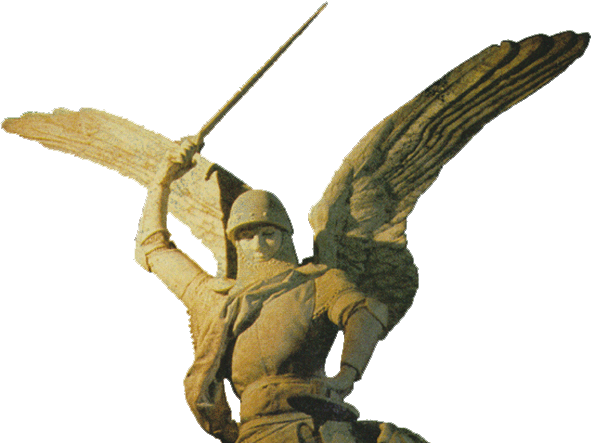
Si Dieu veut que nous honorions tous les Anges, à plus forte raison est-ce Sa Volonté que nous rendions hommage à celui des Esprits célestes qui leva contre Lucifer et les mauvais Anges l'étendard du combat et de la victoire. Le nom de l'Archange Michel signifie: Qui est comme Dieu? C'est, en effet, le cri d'indignation par lequel il rallia autour de lui les Anges fidèles. On représente saint Michel comme un beau jeune homme, le pied levé sur la tête d'un dragon qu'il transperce de sa lance.

Parmi les faits merveilleux qui nous attestent la protection de saint Michel sur l'Église, il faut mentionner son apparition à Rome, où saint Grégoire le Grand l'aperçut dans les airs, remettant son glaive dans le fourreau pour marquer la cessation de la peste et l'apaisement de la colère de Dieu. Mais le 8 mai est destiné à rappeler une apparition non moins merveilleuse, sur le mont Gargan, dans le royaume de Naples.

En l'an 492, un homme, nommé Gargan, faisait paître dans la campagne ses nombreux troupeaux. Un jour, un taureau s'enfuit dans la montagne, où on le chercha d'abord vainement. On tira une flèche; mais cette flèche revint blesser celui qui l'avait tirée. Devant cette merveille, on crut devoir consulter l'évêque voisin. Le prélat ordonna trois jours de jeûne et de prières. Au bout des trois jours, l'Archange saint Michel apparut à l'évêque; il lui déclara que cette caverne où le taureau s'était retiré était sous sa protection, et que Dieu voulait qu'elle fût consacrée sous son nom et en l'honneur de tous les Anges. Accompagné de son clergé et de son peuple, le pontife se rend à cette caverne, qu'il trouve déjà disposée en forme d'église. On y célèbre les divins mystères, et bientôt, dans ce lieu même, s'élevait un temple magnifique où la Puissance divine a opéré de grands miracles.

De tout temps la sainte Église a eu la plus grande vénération pour le glorieux Archange, elle a favorisé son culte, établi des confréries en son honneur; elle nous le montre présentant à Dieu les âmes des justes trépassés et nous invite à l'invoquer pour obtenir, à l'heure de la mort, le dernier triomphe sur les esprits des ténèbres. Ses apparitions à sainte Jeanne d'Arc sont célèbres. Il est regardé comme l'un des grands protecteurs de l'Église et de la France.
(Abbé L. Jaud, Vie des Saints pour tous les jours de l'année)
En ce jour anniversaire de la victoire de 1945, il peut être bon de se rappeler l'importance de la mission de Saint Michel dans l'histoire de notre pays.

Saint Michel et la France


A chaque nation, comme à chaque individu, Dieu a donné un Ange tutélaire, un Ange pour la guider, l'éclairer dans sa marche à travers les siècles ; la soutenir, la protéger dans ses luttes avec les autres peuples, tant qu'elle reste fidèle à sa mission providentielle. Tel est l'enseignement des Pères de l'Eglise et de la sainte Ecriture.

Quel est donc l'Ange gardien de la France ? C'est saint Michel, prince des phalanges célestes et glorieux vainqueur de Lucifer.Comme Dieu avait autrefois choisi les Hébreux parmi les nations païennes, pour conserver et défendre, sous l'égide de saint Michel, la gloire de son nom ; ainsi a-t-il élu le peuple Franc pour être, parmi les nations chrétiennes et sous les auspices du grand Archange, le bouclier et l'épée de son Eglise.Cet honneur, ce privilège divin semble tout d'abord réservé à Constantin, qui tire l'épouse du Christ des catacombes ; mais ses successeurs ne comprennent pas leur mission ; ils ne répondent pas à l'appel divin, et ils disparaissent devant les invasions barbares. Alors saint Michel, apparaissant au mont Gargan, cherche un nouveau peuple pour défendre l'Eglise de Dieu que l'arianisme essayait d'étouffer de toutes parts.Ce nouveau peuple de Dieu est trouvé ; c'est le peuple Franc violemment implanté sur le sol gaulois, peuple ignorant de la foi chrétienne, mais de pur de toute hérésie. Son chef, tout païen qu'il est, a même pleuré au récit de la passion du Sauveur.Pour mieux signaler et cimenter son alliance avec le peuple Franc, Dieu lui envoi son Archange, l'Ange des combats et des triomphes. Après la bataille de Tolbiac, où Clovis entrevit saint Michel, disent certains auteurs, combattant avec lui et lui procurant merveilleusement la victoire, le roi Franc se fait baptiser à Reims, et son baptême devient celui de son peuple.A dater de ce jour, la France marche à la tête des nations. Toujours sûre de son angélique allié, elle porte partout la lumière avec les libertés sacrées de la foi chrétienne. Partout où elle passe, les chaînes tombent, la tyrannie disparaît, la barbarie recule épouvantée.

Ainsi se réalisent, avec une étonnante célérité, les paroles du pape Anastase à Clovis et à sainte Clotilde qui avaient mis la France sous la protection spéciale du glorieux Prince de la milice céleste. "Daigne le Seigneur, leur écrivait le pontife, accorder à vous et à votre royaume sa divine protection ; qu'il ordonne à saint Michel, qui est votre prince et est établi pour les enfants de votre peuple, de vous garder dans toutes vos voies, et de vous donner la victoire sur tous vos ennemis."Avec le secours de l'Archange saint Michel, la France grandit et prospère ; elle mérite le nom glorieux de Fille aînée de l'Eglise.Une des marques éclatantes de la suzeraineté de saint Michel sur la France, c'est sa prise de possession du sol de notre pays. Qui ne connaît, au moins de nom, le mont Saint-Michel ? Qui n'a maintes fois entendu parler de ce rocher de granit qui se dresse entre la Normandie et la Bretagne, sur le littoral de la Manche ? C'est sur ce rocher que saint Michel veut un sanctuaire. En 708, il apparaît trois fois à saint Aubert, évêque d'Avranches, et lui demande une chapelle sur la cime de ce mont, auquel de fréquents naufrages avaient valu le nom sinistre de Tombe au péril de la mer.

Aujourd'hui, ce sanctuaire de saint Michel, transformé par le génie des siècles, par la foi et la renaissance de nos pères, est ce qu'on nomme la merveille de l'Occident et l'un des plus célèbres pèlerinages.Ainsi le mont Tombe, jadis abri du démon et collège de druidesses, est devenu le siège d'honneur et le trône de saint Michel qui, une fois de plus, triomphait de Satan à la place même où celui-ci avait dominé avant le règne de la croix.C'est du rocher du mont Saint-Michel qu'a jailli, comme un torrent, cette foi chevaleresque qui a converti et civilisé l'Europe entière. C'est là que Charlemagne et saint Louis vinrent tour à tour s'agenouiller ; que les Normands, avec Rollon, leur chef, furent adoucis et christianisés, et que Charles VII, remonté sur le trône, se rendit en action de grâces. Plus tard, les sectes hérétiques ont beau inonder la France d'erreurs et de sang, le mont Saint-Michel demeure toujours une forteresse inaccessible à leurs atteintes. Emblème et rempart de la foi, il reste debout au milieu des tempêtes de l'océan, sans en être ébranlé, parce que l'Archange n'a jamais cessé de le couvrir de ses ailes et avec lui toute la France.Voilà pourquoi le peuple Franc, malgré tant d'égarements, reste dans le monde ce qu'il a toujours été, l'ouvrier des grandes choses de Dieu. Même dans notre siècle, où l'on dirait parfois qu'elle a échangé l'étendard de l'Archange contre celui de Satan, n'est-ce pas la France qui, de son sein généreux, a fait sortir et épanouir sur le globe les œuvres de la Propagation de la Foi et de la Sainte-Enfance, œuvres magnifiques qui ont donné tant d'accroissement à l'Eglise, tant d'âmes à Dieu, surtout dans les pays où Satan règne encore par les ténèbres du paganisme ?

O saint Michel, pitié pour notre chère France ! Daignez l'abriter encore sous vos ailes, malgré son ingratitude et ses fautes ; daignez la couvrir de votre bouclier, surtout en ce moment où l'Enfer la dispute au Ciel avec un acharnement effroyable ! Par votre puissant concours, ô divin Protecteur, puisse notre patrie échapper aux étreintes de l'impiété et de la démoralisation qui l'avilissent ; puisse-t-elle redevenir le foyer de la vraie civilisation, la digne fille aînée de l'Eglise, le héraut et le champion de Dieu parmi les nations modernes !

Extrait de "L'Ange Gardien" n°5, Septembre 1895, pp.147-150

Saint Michel, gloire de la France


Saint Michel n'est pas seulement le protecteur, le gardien de la foi de la France, il est encore le promoteur de sa gloire, ainsi que l'attestent les grandes pages de notre histoire nationale.Que l'orgueil apostat de notre temps rejette cette vérité, qu'il refuse effrontément de voir le doigt de Dieu, le surnaturel, dans la marche du peuple franc à travers les siècles, il n'effacera point de notre histoire le souvenir du rôle glorieux de saint Michel. Il faudrait effacer aussi les fastes de la grandeur de la France, fastes qui prouvent que l'illustre Prince du ciel, accomplissant sa mission divine, est venu, d'une manière souvent visible, au secours de notre chère patrie.Dès la formation du peuple franc, à la fin du V° siècle, Clovis prie le Dieu de Clotilde sur le champ de bataille de Tolbiac, et aussitôt les Allemands, éblouis par une vision semblable à celle dont saint Michel avait déjà épouvanté les ennemis de Constantin, prennent la fuite en désordre.Charles-Martel, Charlemagne, ont senti si merveilleusement l'assistance de l'invincible Archange, que le premier envoie son épée au mont Saint-Michel, et le second, au retour de son expédition contre les Saxons, fait peindre l'image de saint Michel sur les drapeaux, avec cette devise : Voici Michel qui m'a secouru.Deux fois, au moins, les croisés voient ce glorieux Archange marcher à l'avant-garde comme leur guide en de lointains pays, et guerroyer à leur tête pour décider la victoire.

Plus tard, quand la France agonisait sous l'invasion des armées anglaises et sous les coups des défaillances suprêmes, n'est-ce pas encore saint Michel qui suscite et dirige Jeanne d'Arc, gloire de la France et libératrice de notre patrie ? dans des visions merveilleuses, l'Archange conte à l'humble bergère des montagnes des Vosges la grande pitié qui était au royaume de France ; il lui donne à profusion lumière te force pour remplir se glorieuse mission ; il fait d'une enfant de seize ans une sainte héroïne qu'il mène constamment triomphante à travers les dangers et la mort. A la bataille d'Orléans, que Jeanne d'Arc gagna le 8 mai, une des fêtes de l'Archange, saint Michel apparut lui-même visiblement sur le pont, racontent les chroniqueurs de l'époque, au moment de l'assaut, et en repoussa les Anglais.La protection de saint Michel fut si manifeste dans la noble mission de la vierge de Domremy que, pour perpétuer le souvenir des victoires qui rendirent à notre beau pays sa gloire, son indépendance et sa nationalité, on fit frapper la monnaie à l'effigie de l'Archange, et louis XI institua l'ordre si célèbre des chevaliers de saint Michel. Sur les étendards, au-dessous de l'image de saint Michel, on lisait les deux devises tirées du prophète Daniel : Voilà que Michel, un des premiers princes, vient à mon secours. – Personne ne vient à mon aide en tout ceci, si ce n'est Michel, votre prince. Le royaume de France s'appela plus que jamais le royaume de saint Michel : Regnum Michaelis, et on s'empressa de rétablir partout les inscriptions que les Anglais avaient fait disparaître : Saint Michel, prince et patron de la France, priez pour nous !

Si l'on parcourait ainsi, siècle par siècle, les annales de nos délivrances et de nos plus glorieux combats, nous verrions toujours saint Michel au poste qu'il a bien voulu prendre avec nous et pour nous. Nous constaterions avec Louis XIV lui-même, qui ne manquait pas de placer ses glorieuses entreprises sous la sauvegarde de celui qui est à la fois l'Ange des combats et l'Ange de la paix, que toute gloire acquise en dehors de son inspiration et de son aide n'est qu'une gloire éphémère et fatale à la patrie.

La France, hélas ! en a fait la triste expérience au commencement de ce siècle.Plus récemment encore, il y a vingt-cinq ans à peine, notre patrie n'a-t-elle pas éprouvé combien il est téméraire de ne compter que sur le nombre des soldats et le courage humain pour arrêter les invasions et éviter les malheurs ? Aujourd'hui même, veut-elle comprendre qu'il y a des invasions plus redoutables que celles des armées ennemies ? que le joug de l'erreur et de l'irréligion est plus pesant que celui de l'étranger ? Ce joug est cependant plus dangereux, car on ne tue pas facilement une nation, mais elle se suicide, lorsque l'impiété y devient à l'ordre du jour. N'est-ce pas l'état de la France ?Puisse-t-elle, après toutes ses infortunes, remonter aux véritables sources de sa grandeur, et revenant s'agenouiller aux pieds de l'Archange tutélaire dont elle a top oublié le culte et les bienfaits, retrouver dans les plis du même drapeau et les élans de sa foi, et le secret de son antique gloire ! Puisse l'Archange, de son côté, oublier nos ingratitudes et montrer bientôt que ce n'est pas en vain que les peuples l'honorent !

Extrait de "L'Ange Gardien" n°6, Octobre 1895, pp.183-185

dimanche, mai 07, 2006

Donec Dies inlucescat!


Donec dies inlucescat
et
Lucifer oriatur
in cordibus vestris.
(2 Pet. 1,19)
Sermon for the third Sunday after Easter
God shows the light of His truth as the collect of this Mass says. This is the little blazing light of the paschal candle we have seen during Easter Vigil from which we lighted all other candles. This symbolizes the souls of the faithful enlightened by the truth of Jesus resurrected and who are the light of the world. For those who have been baptized and received the title of Christians, this is such a gift from God for which they must be thankful. The others, who are still in the darkness, need the light of God to return into the way of righteousness, as the collect asserts.

At the very beginning of the Creation, God made the light, which was good as He saw, and separated the light from the darkness. At the very end of time, Christ, who is the light of the Nations, will separate the sheep from the goats, according to His mission of Good Shepherd as we saw last Sunday. Only the sheep will be introduced to the eternal pasturelands while the goats will definitively cast away into the darkness.

At the very beginning, God called the light Day, and the darkness He called Night. The very last Day of this world will be the Day of the Lord, the Day of His visitation and the Day of the Judgment. The first Christians waited for this Day with Hope as we should also do. There is no reason to fear for the Disciples of Christ. It will be the Day of glory for them. For the others, it might be a Day of confusion and of reprobation, in fact, a night rather than a day.

Between the beginning and the end, is the course of time. In the center, is a major event, which is a renewal of the Day of the Creation and an anticipation of the Last Day; this is the Day of the Resurrection. The week of Easter is totally impregnated with this verse of the Psalm 117 used every day as a Gradual during Mass or as an Antiphon during the Divine Office: Haec Dies quam fecit Dominus: exsultemus et laetemur in ea - This is the day which the Lord has made: let us be glad and rejoice therein.

Pope John Paul II gave a commentary of this Psalm during the general audience of February 12th 2003. I would like to connect this commentary with the collect of today. This Psalm is a hymn of confidence and gratitude to the Lord. The verse 22 refers to the Passion and the Resurrection of Christ: The stone which the builders rejected; the same is become the head of the corner. Christ is this stone, the rock! Pope John Paul II quotes Saint Ambrose: We will therefore let St Ambrose guide our meditation with his Exposition of the Gospel according to Luke. Commenting on Peter's profession of faith at Cesarea Philippi, he recalls that "Christ is the Rock" and that "Christ did not refuse to give this beautiful name to his disciple so that he too might be Peter, and find in the rock the firmness of perseverance, the steadfast solidity of the faith".
Ambrose then introduces the exhortation: "Try hard also to be a rock. However, to do this, do not seek the rock outside yourself but within yourself. Your rock is your actions, your rock is your thoughts. On this rock your house is built, so that it may never be battered by any storm of the evil spirits. If you are a rock, you will be inside the Church because the Church is on the rock. If you are inside the Church, the gates of hell will not prevail against you"

Christ is the Rock. We, as Christians, are other Christ. Today, the Church prays and intercedes for us: grant to all those who profess themselves Christians to reject those things which are contrary to that name, and follow such things as are agreeable to the same. We can reject the things which are contrary to the name of Christian precisely by becoming a rock. This presupposes a total fidelity to Our Lord Jesus Christ and His Church, with no compromise with the world.
Dear Brethren, we have to be strong, because it is easy to choose the side of the world; it is much easier than choosing the camp of the Saints. The world shall rejoice! These are the words of Jesus in today’s Gospel. The world shall rejoice! It shall rejoice, because it knows only the terrestrial joys. But it also shall rejoice at our tribulations. Being a Christian means to be a stone rejected by the builders of the world. Look, Europe has already disowned its Christian roots! Say something not politically correct against the Jews or the Muslims, and you will be taken to the Court. Say or do something against the Christians, especially against the Catholics, nobody cares. A new world is built since the French Revolution. And this new world doesn’t want Jesus Christ. The darkness want to recover its territories. It seems that Jesus has gone. It is a profound sadness for his disciples. But let them don’t forget his words: Amen, amen I say to you, that you shall lament and weep, but the world shall rejoice; and you shall be made sorrowful, but your sorrow shall be turned into joy.

We are waiting for the Day of the Lord which will come soon. Jesus attests it through the pen of Saint John at the end of the Apocalypse: Surely I come quickly. The answer of the faithful is Amen! Come Lord Jesus! (Ap 22,20)
A true disciple of Jesus loves Him and wants to see Him. May Our Lady give us this love and desire. May she help us to keep his words until the Day when He will come again. Saint Peter tells us with beautiful words: And we have the more firm prophetical word: whereunto you do well to attend, as to a light that shines in a dark place, until the day dawn, and the day star arise in your hearts. – Donec dies inlucescat et Lucifer oriatur in cordibus vestris.(2 P 1, 19)

Let us live with the Hope of this day, which could be today, if we listen to the voice of God and are faithful to it. Hodie si vocem eius audieritis nolite obdurare corda vestra - Today if you shall hear his voice, harden not your hearts (Ps 94)… because the Day of the Lord is already…today!

lundi, mai 01, 2006

The good Shepherd


Sermon for Good Shepherd Sunday


Today’s liturgy is particularly comforting. It shows us the face of Christ as the Good Shepherd. Ego sum pastor bonus – I am the Good Shepherd. The Good Shepherd tells Himself what he does for us: He gives His life for His sheep. He knows it. The words of Jesus always come true. He truly knows and loves us. Knowledge and love imply a certain closeness. The knowledge of a being is the possession of this known being by the intellect of the one who knows. A perfect knowledge involves a very close closeness, or intimacy if it is about persons. For example, the Bible uses the word ‘to know’ to signify the union between spouses. Adam knew Eve his wife: who conceived and brought forth Cain.

In this way, we can say that knowledge is productive. As Saint Thomas Aquinas points out, we use the same word to express the conception of a baby and the conception of an idea. In God, knowledge is eminently productive, simply because the act of His intellect is His own substance. In other words, for God, being and knowing are the same thing. God’s knowledge of Himself is so perfect and so intense that it produces something which is similar to Himself. There is always a similitude between the object known and thought and the intellect which knows and thinks it. And because in God, the act of knowing or thinking is the same as the act of being, the fruit of the knowledge of Himself by God is God Himself, known as the Word of God, the Second Person of the Blessed Trinity. The Father conceives His Son from all eternity.
And God also knows us. There are so many things to say about this. He knows us means He has created us. In fact, He creates us would be better, since there is no time for God. He knows us; He loves us; he creates us: all these expressions are synonymous. God thinks about us before we already exist, and because He thinks about, us we exist. the Psalm 138 says: Mirabilis facta est scientia tua. In English we say: Thy works are wonderful. But the exact translation for ‘scientia’ is science or knowledge. Nevertheless the word ‘works’ is not false because the science of God is His works. And the Psalm 138 signifies this fact very well. Praising the knowledge of God, this Psalm claims His supremacy. Thy knowledge is become wonderful to me: it is high, and I cannot reach to it. Whither shall I go from thy spirit? or whither shall I flee from thy face? If I ascend into heaven, thou art there: if I descend into hell, thou art present. More precisely God knows each of us very well: Lord, thou hast proved me, and known me: Thou hast know my sitting down, and my rising up. Thou hast understood my thoughts afar off: my path and my line thou hast searched out. And thou hast foreseen all my ways: for there is no speech in my tongue. Behold, O Lord, thou hast known all things, the last and those of old: thou hast formed me, and hast laid thy hand upon me.

God knows us. He also loves us. God’s act of loving is one and the same with his act of being, as it is also for His knowing. God is love. Deus caritas est, as Pope Benedict XVI recalled it recently. Father Cantalamessa, preacher to the Papal Household, said, in his sermon for Good Friday in Saint Peter’s Basilica, that if we had to keep only one sentence from the Bible, it should be this one, from the first epistle of Saint John: God is charity. This is the perfect summary of the entire Bible because it expresses what God is. God is charity.
We have to use human words to speak about God and our words are often inadequate and not precise enough. In fact, who God is can be perfectly and totally expressed in only one word, which is His Son, the Uncreated Word. The Father sees Himself in the Son and delights in this contemplation as the Son delights in reflecting His Father. And from this mutual love between the Father and the Son, the Holy Ghost proceeds.

The Incarnation of the Word is the visible expression in the world of the Divine Life within the Blessed Trinity. God is now visible, through the Person of the Son, the Good Shepherd who knows and loves us.
Dear Brethren, I think we can wonder. And we should wonder. How is it possible that God loves us so much, to such a degree, that the Son assumed our nature, became one of us and died for us? As Saint Paul asserts, it is truly a stumbling block unto the Jews, and foolishness unto the Gentiles. Whatever the reasons are for God’s love for us, it is a fact that He loves us. The reason for His love is perhaps, simply, that He is love. Or maybe there are no other reasons for loving than love itself!

The Good Shepherd knows us and loves us. But what about us. Do we know Him? It is important to think about this because the sheep know their Shepherd. I mean, they really know Him. They can recognize His voice and they listen to it and heed it. It is not about a kind of academic knowledge that everyone can obtain just by opening a catechism. Well, Jesus Christ is the Second Person of the Blessed Trinity, Son of God made man, true God and true man and who came into the world to redeem us. Excellent! You know your catechism. But the true and good sheep know more about their Shepherd than these basic definitions printed in a catechism. They recognize His voice as Mary Magdalene did when He called Her Mary. The sheep have more than an intellectual knowledge of Jesus. They have the knowledge of the heart, the knowledge which allows us to comprehend, with all the saints, what is the breadth, and length, and height, and depth as Saint Paul Says again. This is the kind of knowledge that comes with love, which is not necessarily the case with the mere intellectual knowledge of God. You can know your catechism perfectly as well as the teachings of the Church, just as you can know Mathematics or History, and live far from God. In spite of your erudition, you are not able to recognize and hear the voice of Jesus when he calls you.

But the deep and true knowledge of God, which is obtained not only by studies but also through prayer and meditation, necessarily goes with love. In fact, they call each other. The more you love God, the more you want to know about Him and the more you know Him, the more you love Him. Then, you follow your Shepherd spontaneously, just because you love Him and you trust in Him. You acknowledge that He is your Shepherd and that only He can lead you to the eternal pasture where you will be for eternity introduced into the great mystery of the Love of the Blessed Trinity.

So dear Brethren, let us turn to Our Lady, so that she can teach us how to open the ears of our soul and hear the voice of the Good Shepherd. It is the invitation that Saint Benedict addresses to us in his rule: Listen, O my son, to the precepts of thy master, and incline the ear of thy heart, and cheerfully receive and faithfully execute the admonitions of thy loving Father. Incline the ear of thy heart…. This is the condition for following Jesus. May Our Lady help us to do it!